Wine Guides & Pairings

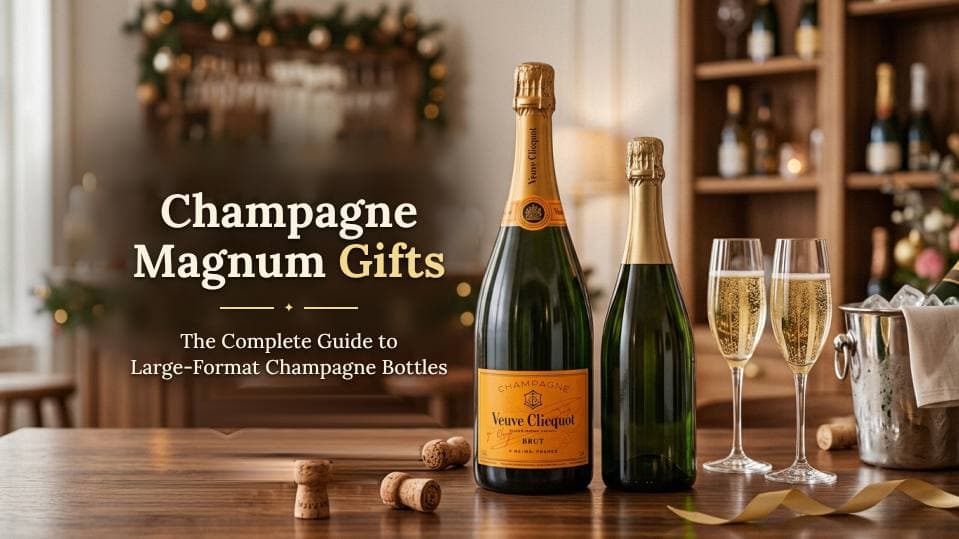
Champagne Magnum Gifts: The Complete Guide to Large-Format Champagne Bottles
6
Oct
Admin 2 55

Champagne Magnum Gifts: The Complete Guide to Large-Format Champagne Bottles

Quick answer: A champagne magnum is a 1.5-litre bottle that holds the same as two standard 750 ml bottles and pours about 12 glasses. Bigger formats follow: the Jeroboam or double magnum (3 L, 4 bottles), Rehoboam (4.5 L), Methuselah (6 L), Salmanazar (9 L), Balthazar (12 L), Nebuchadnezzar (15 L), and the giant Melchizedek (30 L, 40 bottles). Champagne ages more slowly and gracefully in a magnum, which is why it makes such a standout gift.

There's a particular sound a room makes when someone walks in carrying a champagne magnum. It's half gasp, half laugh, and it usually ends with someone asking, "Wait, how much is in that thing?"

If you're thinking about giving one, you're on to something. A magnum, or any large-format champagne bottle, is more than extra wine. It ages better, pours finer bubbles and turns a toast into a moment people remember. It's also one of the few gifts that gets better the longer it's kept.

What is a champagne magnum?

A champagne magnum is a bottle that holds 1.5 litres of champagne. That's 150 cl, 1,500 ml or about 50.7 US fluid ounces. The word comes from the Latin magnus, meaning "great", and it's the first and most popular of the large-format bottles. In the wine trade, "large format" means anything bigger than the standard 750 ml bottle.

A magnum champagne bottle is big enough to feel like an occasion, yet you can still carry it in one hand, chill it in a decent ice bucket and pour it without help. That balance is why it's the size most people picture when they say "a big bottle of champagne".

Is a magnum champagne?

It's one of the most searched questions about magnums. A magnum is a bottle size, not a type of wine. You'll find magnums of Bordeaux, Napa Cabernet and Pinot Noir too (we stock several, further down). But no region has made the format its own like Champagne. Most great houses bottle their flagship cuvées in magnum, and many cellar masters say it's their favourite size to drink. So while not every magnum is champagne, the champagne magnum is the one everybody pictures.

How many bottles are in a magnum of champagne?

There are two standard bottles of champagne in a magnum. A standard bottle holds 750 ml and a magnum holds 1.5 litres, exactly double. For a party, one magnum replaces two regular bottles, with a lot more theatre.

How many glasses are in a bottle of magnum champagne?

A magnum pours around 12 glasses at a standard 125 ml (about 4 oz) pour. The real number depends on your glassware and how generous the pourer is.

Pour stylePour sizeGlasses per magnum
Generous dinner pour150 ml10
Standard flute125 ml12
Toast-only pour100 ml15

Rule of thumb: one magnum comfortably serves six people for an evening at two glasses each, or 12 to 15 people for a single toast.

Magnum vs standard champagne bottle

Standard bottleMagnum
Volume750 ml (25.4 oz)1.5 L (50.7 oz)
Standard bottles12
Glassesabout 6about 12
Ageing potentialGoodExcellent: slower and more graceful
Bubbles with ageCan coarsen soonerStay finer for longer
Chilling in an ice bucket20–30 min45–60 min
PriceBaselineUsually two bottles plus 10–20%
Gift impactThoughtfulUnforgettable

For a quiet dinner for two, a standard bottle is perfect. When there's a crowd, a milestone or a gift involved, the magnum wins almost every time.

Champagne bottle sizes: the complete large-format chart

Past the magnum, champagne bottle names turn biblical and the bottles get seriously big. Here's every format you're likely to meet, from a single-serve split to a bottle that takes two people to pour.

Bottle heights are approximate and drawn to one scale. The magnum and Jeroboam (double magnum), highlighted in gold, are the gifting sweet spot.

Bottle nameVolumeStandard bottlesGlassesBest for
Quarter / Split / Piccolo187.5 ml¼1–2Wedding favours, a solo treat
Half bottle / Demi375 ml½3Dinner for two
Standard750 ml16Small dinners
Magnum1.5 L212Dinner parties, gifts, cellaring
Jeroboam (Double Magnum)3 L424Milestone birthdays, engagements
Rehoboam4.5 L636Family gatherings
Methuselah6 L848Weddings
Salmanazar9 L1272Galas, corporate events
Balthazar12 L1696Large receptions
Nebuchadnezzar15 L20120Grand openings, launches
Solomon / Melchior18 L24144Showpiece celebrations
Sovereign26.25 L35210Very rare, made to order
Primat / Goliath27 L36216Very rare, made to order
Melchizedek / Midas30 L40240The biggest champagne bottle

Where do the champagne bottle names come from?

Nobody knows exactly who first named large champagne bottles after kings, but the habit has stuck for well over a century. Most are figures from the Old Testament, which makes a nice story to tell when you hand over the gift.

  • Jeroboam (3 L): The first king of the northern kingdom of Israel.
  • Rehoboam (4.5 L): Solomon's son, and king of Judah.
  • Methuselah (6 L): Said to have lived 969 years. Fitting for a bottle built to age.
  • Salmanazar (9 L): An Assyrian king, Shalmaneser.
  • Balthazar (12 L): One of the three wise men.
  • Nebuchadnezzar (15 L): The king of Babylon behind the Hanging Gardens.
  • Solomon (18 L): King David's son, famed for wisdom and wealth.
  • Melchizedek (30 L): A priest-king of Salem, and the oldest name on the list.

Double magnum vs Jeroboam: don't get caught out

In Champagne, a Jeroboam and a double magnum are the same bottle: 3 litres, or four standard bottles. Bordeaux plays by different rules. There, a double magnum is 3 litres, but a "Jeroboam" traditionally holds 4.5 to 5 litres. When you shop for a champagne big bottle, check the litres on the label rather than the name alone.

Which large formats can you actually buy?

Magnums are easy to find from almost every house. Jeroboams are widely made by the major brands. From the Rehoboam upward, the champagne is usually fermented in standard bottles or magnums and transferred under pressure into the giant bottle, because enormous bottles are too heavy to riddle and disgorge. Those formats are made in tiny numbers, often to order. For most gifts, the magnum and double magnum hit the sweet spot: impressive, available and still liftable.

Why champagne tastes better in a magnum

Ask a sommelier which size they'd choose for a special vintage and the answer is almost always the magnum. There's real science behind it.

The ullage effect

  • The air pocket under the cork (the ullage) is about the same size in both bottles.
  • The magnum has twice the wine underneath it.
  • So each glass sees roughly half the oxygen, and the champagne ages more slowly.

Less oxygen per glass

Oxygen is what slowly ages a wine and eventually tires it. Spread the same small pocket of air over twice the champagne and the wine evolves more gradually, keeping its tension and freshness.

Slower, more even ageing

A bigger volume of liquid warms and cools more slowly, so it's better protected from the small temperature swings that stress wine in storage. The champagne matures steadily on its lees, building complexity without losing its spark.

Finer bubbles and more freshness

Taste the same champagne at the same age from a standard bottle and a magnum, and the magnum usually shows finer, creamier bubbles, brighter acidity, and deeper brioche, toasted-almond and honey notes with a smoother finish.

Producers save their best for it

Large formats are fiddly and often handled by hand at every stage, so many houses reserve their finest blends, prestige cuvées and vintage releases for them.

Size helps, but it isn't magic. A young non-vintage magnum opened on release tastes much like the standard bottle. The magnum's advantage shows most after 5, 10 or even 20+ years of good storage, which is what makes a vintage magnum such a thoughtful gift.

Why a champagne magnum makes the perfect gift

Most gifts get opened and put away. A champagne magnum gets shared, and that's the point. It says "celebrate with the people you love" without you having to say it.

  • It's instantly special. Nobody mistakes a magnum for an everyday bottle.
  • It's made with extra care. Large formats are often riddled and disgorged by hand.
  • It can be kept for years. A vintage magnum can wait for an anniversary or a child's 18th, improving the whole time.
  • It's a centrepiece. A large champagne bottle becomes part of the table, the photos and the story of the day.
  • It's practical for hosts. One bottle serves a dozen guests, with fewer corks and fewer trips to the fridge.

Which size for which occasion?

OccasionBest formatWhy it works
Dinner party or housewarmingMagnumEnough for the whole table. Try Veuve Clicquot or Billecart-Salmon.
Engagement or anniversaryRosé or vintage magnumRomantic, and it can be kept for a future date. Try the Moët Rosé gift basket.
Milestone birthdayMagnum or JeroboamA 30th, 40th or 50th deserves a big bottle.
Wedding toastJeroboam or MethuselahServes 24 to 48 from one photogenic bottle.
Corporate or client giftMagnum, gift-boxedPolished, premium and remembered. Ask us about bulk orders.
Christmas or New Year's EveDouble magnumThe showpiece at midnight.
Birth or christeningVintage magnumChoose the birth year and open it together at 18 or 21.
Promotion or retirementMagnum + engravingPersonal and celebratory.
Festive giftingMagnumDiwali, Eid, Lunar New Year or Thanksgiving gatherings.

Make the gift unforgettable

The bottle is the star, but presentation finishes the job: a wooden case or premium gift box, a personalised bottle or handwritten tag with the date, a pair of crystal flutes, a champagne saber for a dramatic opening, or a "do not open until" note for a vintage magnum meant for the cellar.

Our champagne magnums, ready to gift

Here are the 1.5-litre bottles our customers reach for most, from a crowd-pleasing prosecco to a prestige vintage. Every one ships ready to give.
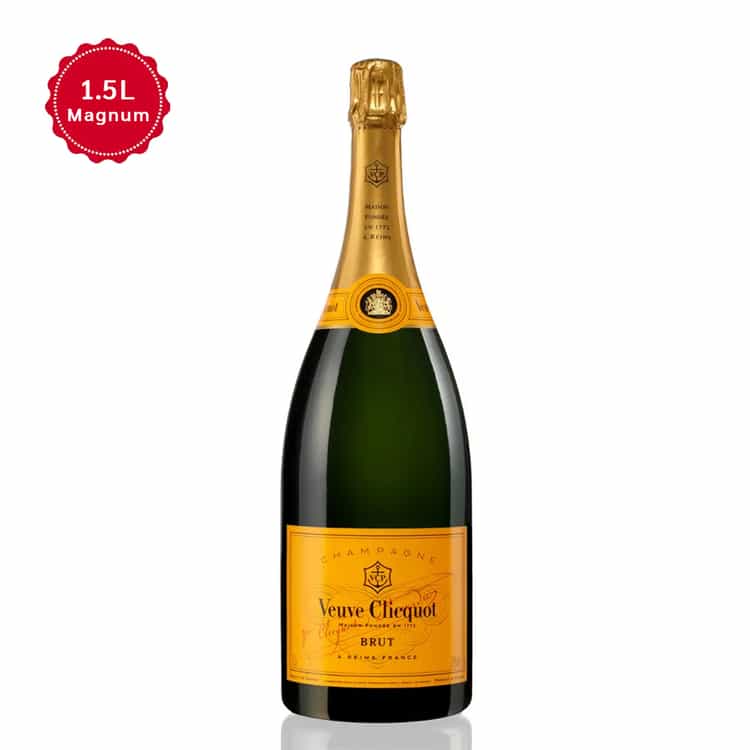
Veuve Clicquot Magnum Brut Champagne 1.5 litre

Brut · Bestseller

Veuve Clicquot Magnum Brut Champagne

The famous Yellow Label. Pinot Noir-led, rich and toasty, and instantly recognisable.

$229

Shop
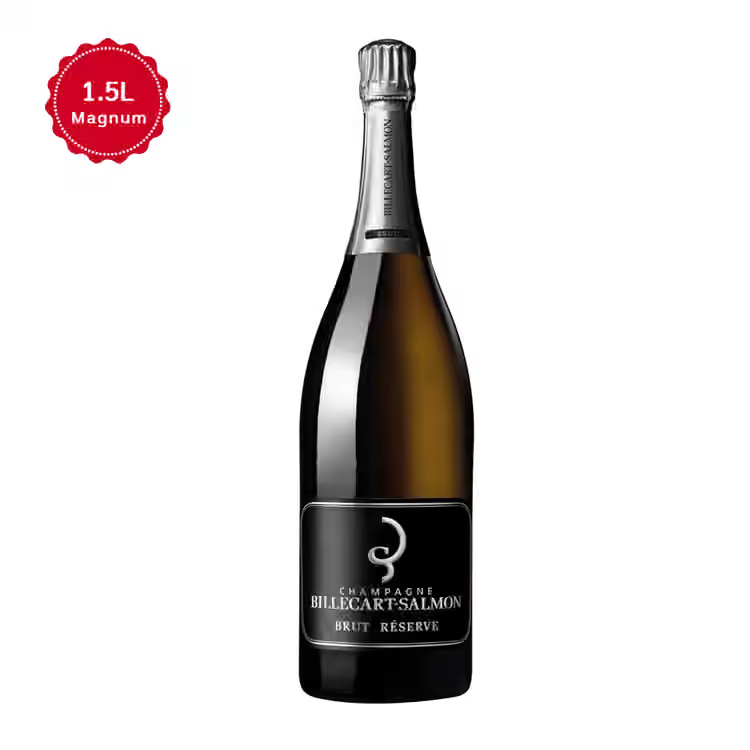
Billecart-Salmon Brut Réserve champagne magnum 1.5 litre

Brut · Sommelier's pick

Billecart-Salmon Brut Réserve Magnum

Fresh, precise and elegant. A favourite of wine lovers who know their champagne.

$199

Shop
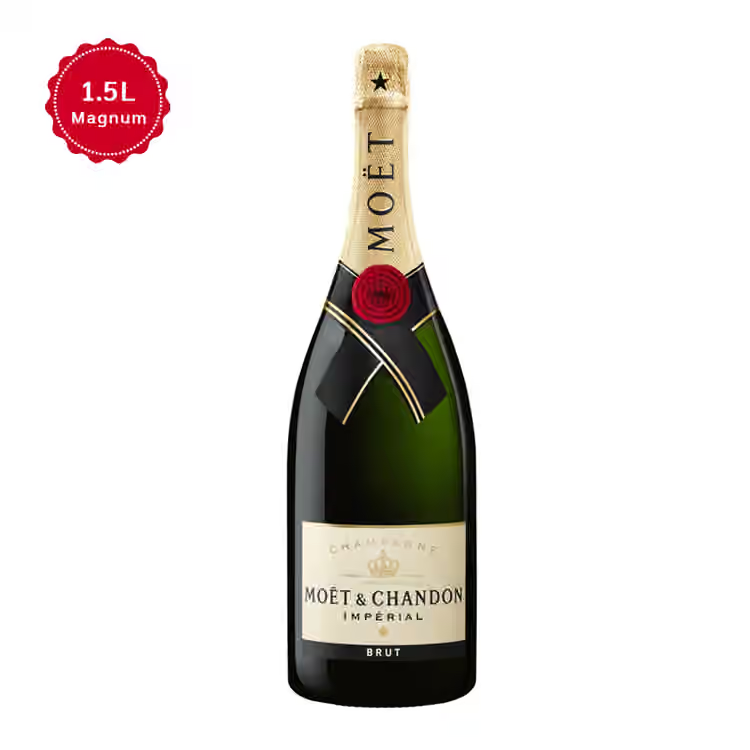
Moët & Chandon Impérial Brut champagne magnum

Brut · Party classic

Moët & Chandon Impérial Brut Magnum

The world's best-known champagne, bright and fruity. A magnum of Moët is a party icon.

$179

Shop
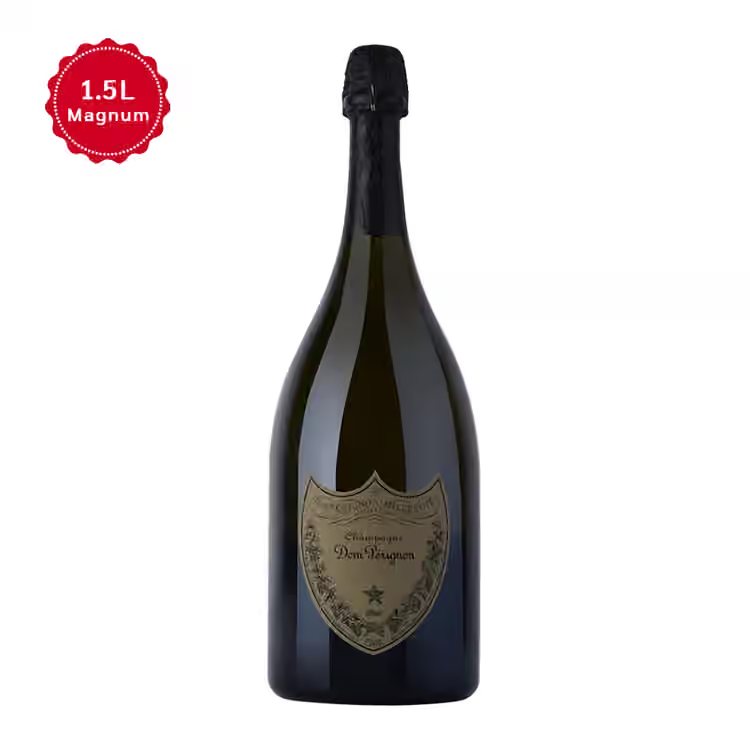
Dom Pérignon vintage champagne magnum

Vintage · Prestige

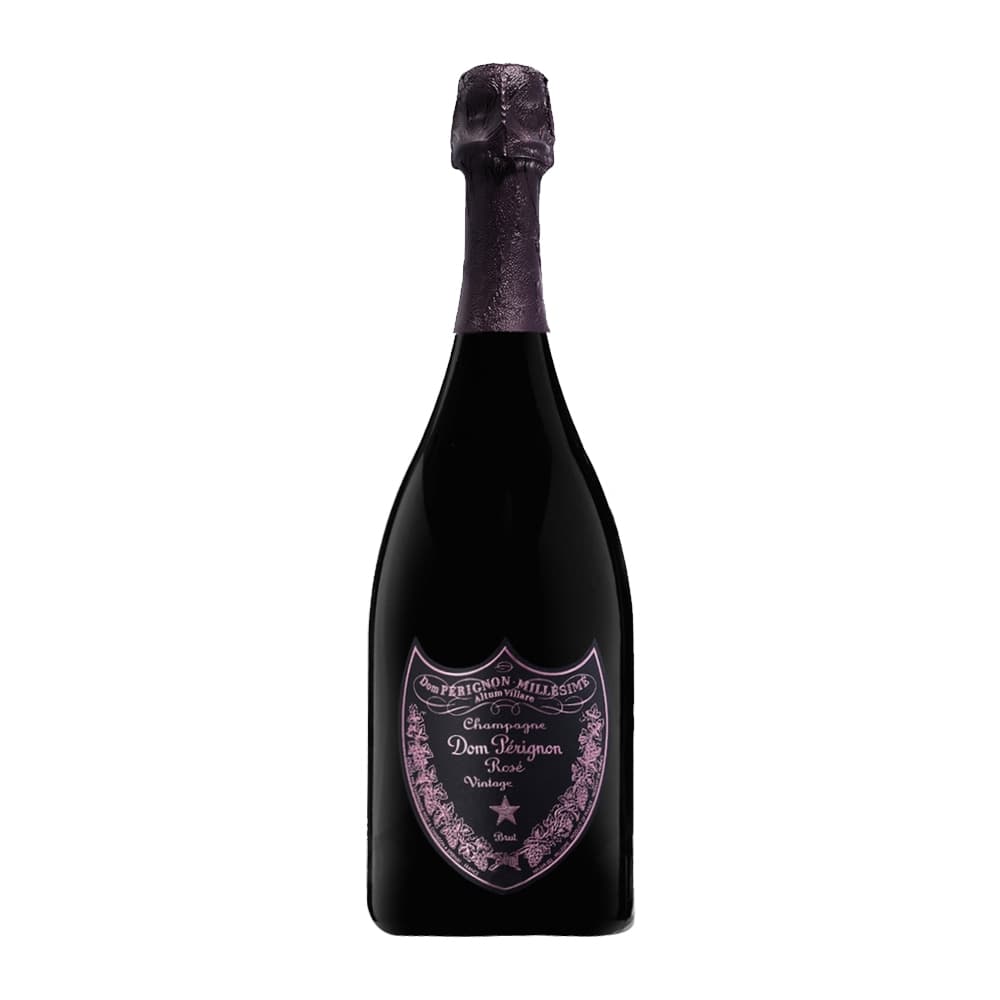
Dom Perignon Magnum Brut Champagne - 1.5L

Made only in great years and built to age. The magnum for once-in-a-lifetime moments.

$1049

Shop
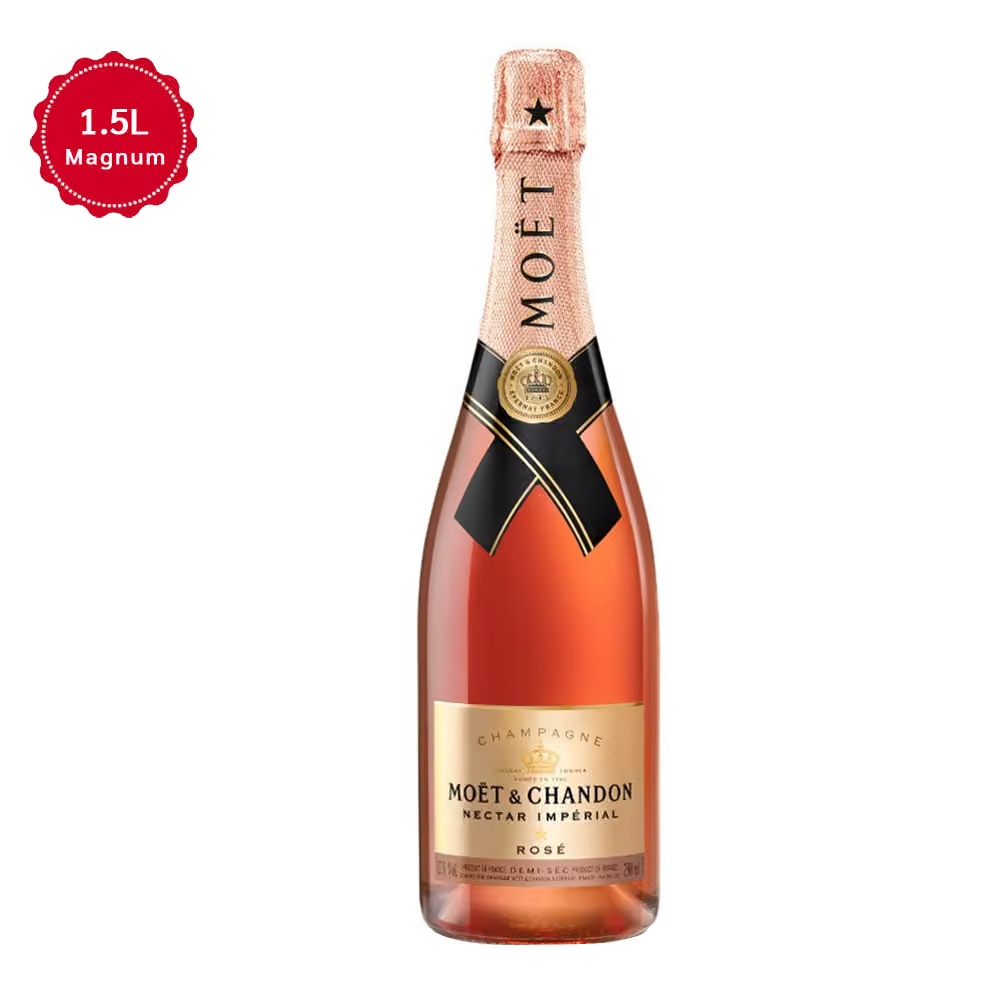
Moët & Chandon Nectar Impérial Rosé Luminous magnum 1.5 litre

Rosé · Sweeter style

Moët & Chandon Nectar Impérial Rosé Luminous Magnum

A fruit-forward, gently sweet rosé in a bottle that glows. Made for parties and nightlife.

$149

Shop
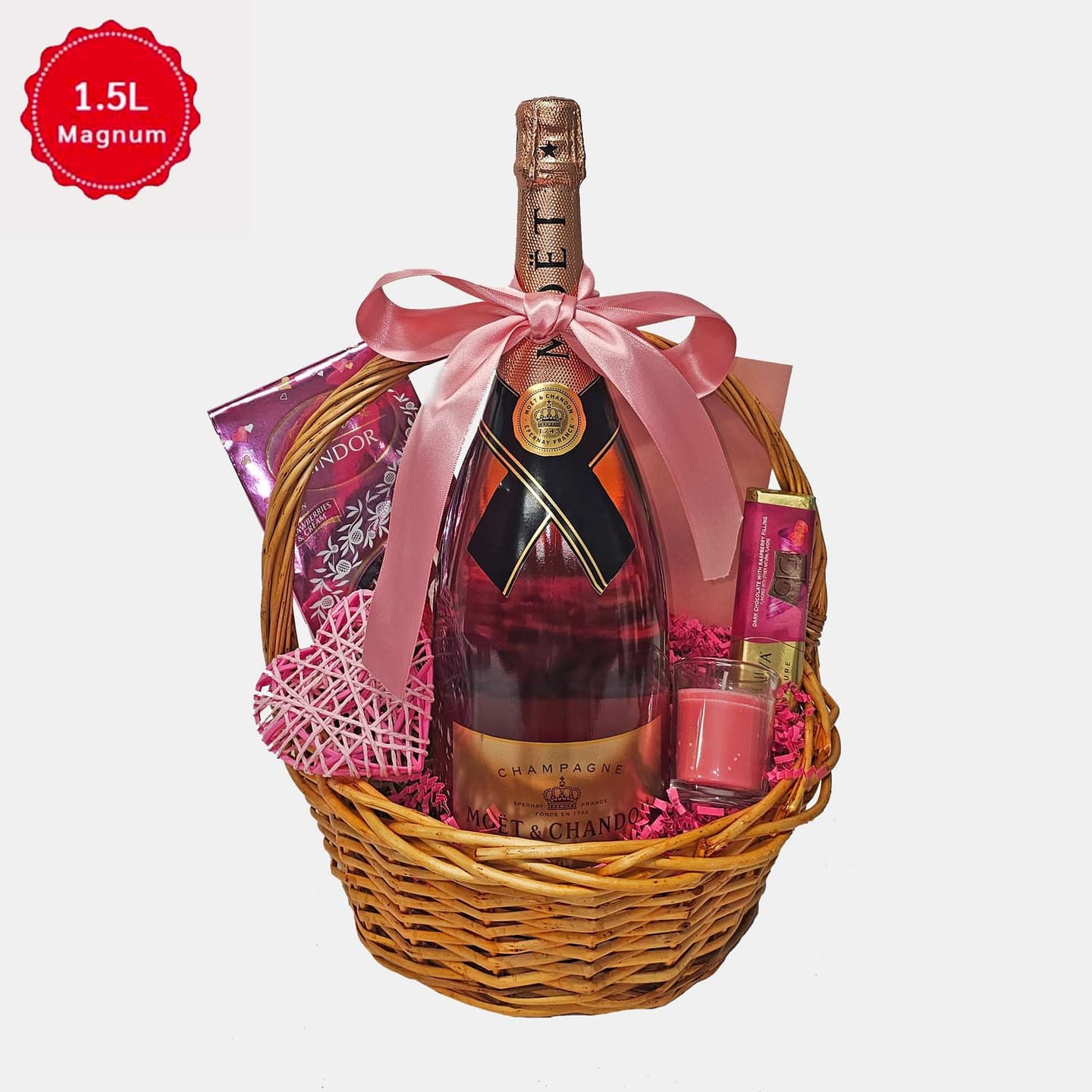
Moët & Chandon magnum rosé celebration gift basket

Rosé · Gift basket

Moët & Chandon Magnum Rosé Celebration Gift Basket

A rosé magnum dressed up and ready to hand over. Ideal for anniversaries and birthdays.

$199

Shop

See all 22 magnums

How many magnums do you need?

Move the slider to your guest count and pick the kind of event. The estimate uses a standard 125 ml glass and 12 glasses per magnum.

Party planner
Champagne magnum calculator
20
Type of event
4
magnums for 40 glasses (48 poured)
Shop magnums

How to choose the right champagne magnum

Choosing a big bottle of champagne comes down to three questions: who's drinking it, when will it be opened, and what do they like?

  1. Match the size to the crowd. Allow two glasses per guest for a party and one for a toast. For 4 to 6 people, choose a magnum. For 10 to 12, a Jeroboam or two magnums. For 20 or more, a Methuselah makes the moment.
  2. Pick the style.
    • Brut non-vintage: the house signature, balanced and ready to drink.
    • Extra Brut or Brut Nature: very dry and precise.
    • Blanc de Blancs: 100% Chardonnay. Citrusy, mineral, elegant.
    • Blanc de Noirs: Pinot Noir and Meunier. Rounder and richer, great with food.
    • Rosé: the romantic pick for anniversaries and weddings.
    • Vintage or prestige cuvée: made only in great years, and the style that benefits most from a magnum.
  3. Think about timing. Opening it this month? Go for a non-vintage brut or rosé. Opening it in ten years? Choose a vintage magnum and let the format do its work.
  4. Know the recipient. Big-brand lovers light up at a famous label. Wine enthusiasts often get more excited by a grower champagne from a small family estate.
  5. Order early. Large formats are made in small runs and often sell out before Christmas and New Year.

Champagne houses known for great magnums

HouseWhy it's a great magnum gift
Moët & ChandonThe world's best-known champagne. Impérial and Rosé magnums are party icons.
Veuve ClicquotThe famous Yellow Label, with a rich Pinot-led style.
Billecart-SalmonPrecise and stylish, much loved by sommeliers.
Dom PérignonVintage-only prestige champagne for once-in-a-lifetime moments.
BollingerFull-bodied and toasty, a favourite of serious champagne fans.
Pol RogerElegant and refined, with a long royal heritage.
TaittingerChardonnay-driven, fresh and graceful.
Laurent-PerrierIts Cuvée Rosé is one of the best-loved rosé champagnes.
RuinartThe oldest established champagne house, known for Blanc de Blancs.
Krug, CristalPrestige magnums for the very biggest celebrations.

How much does a champagne magnum cost?

As a rough guide, a magnum costs the price of two standard bottles plus 10 to 20%. The extra covers the thicker glass, bigger cork, specialist handling and smaller production runs.

BudgetWhat you getFrom our collection
Under $100Prosecco and value sparklingLa Marca Prosecco Magnum, $89
$100–$250Big-name non-vintage champagne and roséMoët Nectar Rosé $149, Billecart-Salmon $199,  Moët Rosé Gift Basket $199, Veuve Clicquot $229
$250+Prestige cuvées, vintage champagne and cult winesDom Pérignon $1049,  Opus One $1,499

Is a champagne magnum worth it?

Per glass, a magnum is rarely the cheapest way to buy champagne. What you're paying for is better ageing, finer bubbles and a gift that people photograph and remember. For a celebration, a crowd or a bottle meant for the cellar, it's worth every dollar.

How to serve a champagne magnum

A magnum rewards a little planning. It holds twice the wine, so it takes longer to chill and needs a steadier hand to pour.

Chilling methodTime for a magnum
Refrigerator4–6 hours
Ice bucket with ice and water45–60 min
Ice bucket, ice only90 min +
FreezerNot recommended for a pressurised bottle

Serve non-vintage champagne at 8–10°C (46–50°F). Older vintage magnums show their complexity best slightly warmer, at 10–12°C (50–54°F). Use a large bucket so the bottle sits submerged up to the neck.

How to open and pour a magnum

  1. Dry the bottle completely so it can't slip.
  2. Remove the foil and untwist the cage (six half-turns) while keeping a thumb firmly on the cork.
  3. Hold the bottle at 45°, pointed away from people. Grip the cork and turn the bottle, not the cork.
  4. Ease it out slowly for a soft sigh rather than a loud pop. The sigh keeps more bubbles in the wine.
  5. To pour, put your thumb in the punt (the dimple in the base) and spread your fingers under the bottle, steadying the neck with your other hand.
  6. Pour in two stages: a splash first, then top up once the foam settles. Return the bottle to the ice between rounds.

Can you saber a champagne magnum?

Yes, and it's spectacular. Chill the bottle thoroughly, remove the foil and cage, find the vertical seam and slide a champagne saber firmly along it toward the lip. Always point it away from people, pets and windows. A magnum is heavier and less forgiving than a standard bottle, so practise on a 750 ml first.

What to eat with a magnum of champagne

  • Brut and Blanc de Blancs: Oysters, sushi, smoked salmon, tempura, salted crisps, pakoras and samosas.
  • Blanc de Noirs: Roast chicken, mushroom dishes, aged cheeses and buttery seafood.
  • Rosé: Salmon, duck, tandoori dishes, charcuterie and berry desserts.
  • Vintage and prestige: Truffle dishes, lobster, aged Comté or Parmesan.

How to store a champagne magnum

A magnum ages beautifully, but only if it's stored properly.

  • Cool and steady: ideally 10–13°C (50–55°F), without big swings.
  • Dark: light damages champagne, so keep it away from windows and bright bulbs.
  • Still: away from vibration such as washing machines or a fridge motor.
  • On its side for long-term storage so the cork stays moist. Upright is fine for a few weeks.
  • Humid enough, around 70%, to stop the cork drying out.

Non-vintage magnums are best within 3 to 5 years of purchase. Vintage and prestige magnums can reward 10, 20 or even 30 years in a proper cellar.

Common mistakes to avoid with large-format champagne

  • Under-chilling it. A warm magnum gushes foam and tastes flat.
  • Underestimating the weight. Pouring one-handed from a full magnum invites spills.
  • Buying too little. One magnum is about 12 glasses. If guests will want seconds, plan for it.
  • Opening a great vintage too soon. If it's built to age, let it.
  • Storing it upright on a sunny shelf. The quickest way to ruin a special bottle.

Fun facts about champagne magnums

  • A Salmanazar is a whole case: Its 9 litres equal exactly 12 standard bottles, in one piece of glass.
  • Giant bottles are filled from smaller ones: From about 4.5 litres up, champagne is usually made in smaller bottles and transferred under pressure.
  • Magnums cost a little more per glass: Thicker glass, smaller runs and hand handling all add up.
  • The sommelier's sweet spot: Big enough to age beautifully, small enough to chill and pour without help.
  • Not just for big days: Some champagne lovers keep a "Magnum Friday" ritual. A big bottle turns any evening into an occasion.
  • Fewer bottles, smoother party: One magnum instead of two bottles means fewer corks, fewer interruptions and a steadier temperature all night.

Champagne magnum FAQs

What is a champagne magnum?

A champagne magnum is a 1.5-litre bottle of champagne, double the standard 750 ml size. It pours about 12 glasses.

Is a magnum champagne?

A magnum is a bottle size, not a type of wine. Champagne is the wine most famously sold in magnums, but red, white and other sparkling wines come in magnums too.

How many bottles are in a magnum of champagne?

Two. A magnum holds the same as two standard 750 ml bottles of champagne.

How many bottles of champagne are in a double magnum?

Four. A double magnum, called a Jeroboam in Champagne, holds 3 litres and pours about 24 glasses.

How many glasses are in a magnum of champagne?

About 12 standard flutes, 10 generous pours, or up to 15 small toasting pours.

How many ounces are in a champagne magnum?

About 50.7 US fluid ounces (1,500 ml).

What is a large bottle of champagne called?

It depends on the size: Magnum (1.5 L), Jeroboam or double magnum (3 L), Rehoboam (4.5 L), Methuselah (6 L), Salmanazar (9 L), Balthazar (12 L), Nebuchadnezzar (15 L), Solomon (18 L) and Melchizedek (30 L).

What is the biggest champagne bottle?

The Melchizedek, also called a Midas, holds 30 litres: 40 standard bottles or roughly 240 glasses. It's extremely rare and usually made to order.

Does champagne age better in a magnum?

Yes. The air under the cork is spread over twice as much wine, so the champagne ages more slowly and keeps its freshness and fine bubbles longer.

How long does it take to chill a champagne magnum?

About 45 to 60 minutes in an ice bucket with ice and water, or 4 to 6 hours in the fridge.

How much does a champagne magnum cost?

Usually around the price of two standard bottles plus 10 to 20%. Our champagne magnums start at $149, with prosecco magnums from $89.

Is a champagne magnum a good gift?

Yes, one of the best. It's generous, ages well, looks spectacular and is made to be shared, which makes it ideal for weddings, anniversaries, milestone birthdays and corporate gifting.

How long does a magnum last once opened?

Sealed with a proper champagne stopper in the fridge, about 2 to 3 days, though the bubbles fade a little each day.
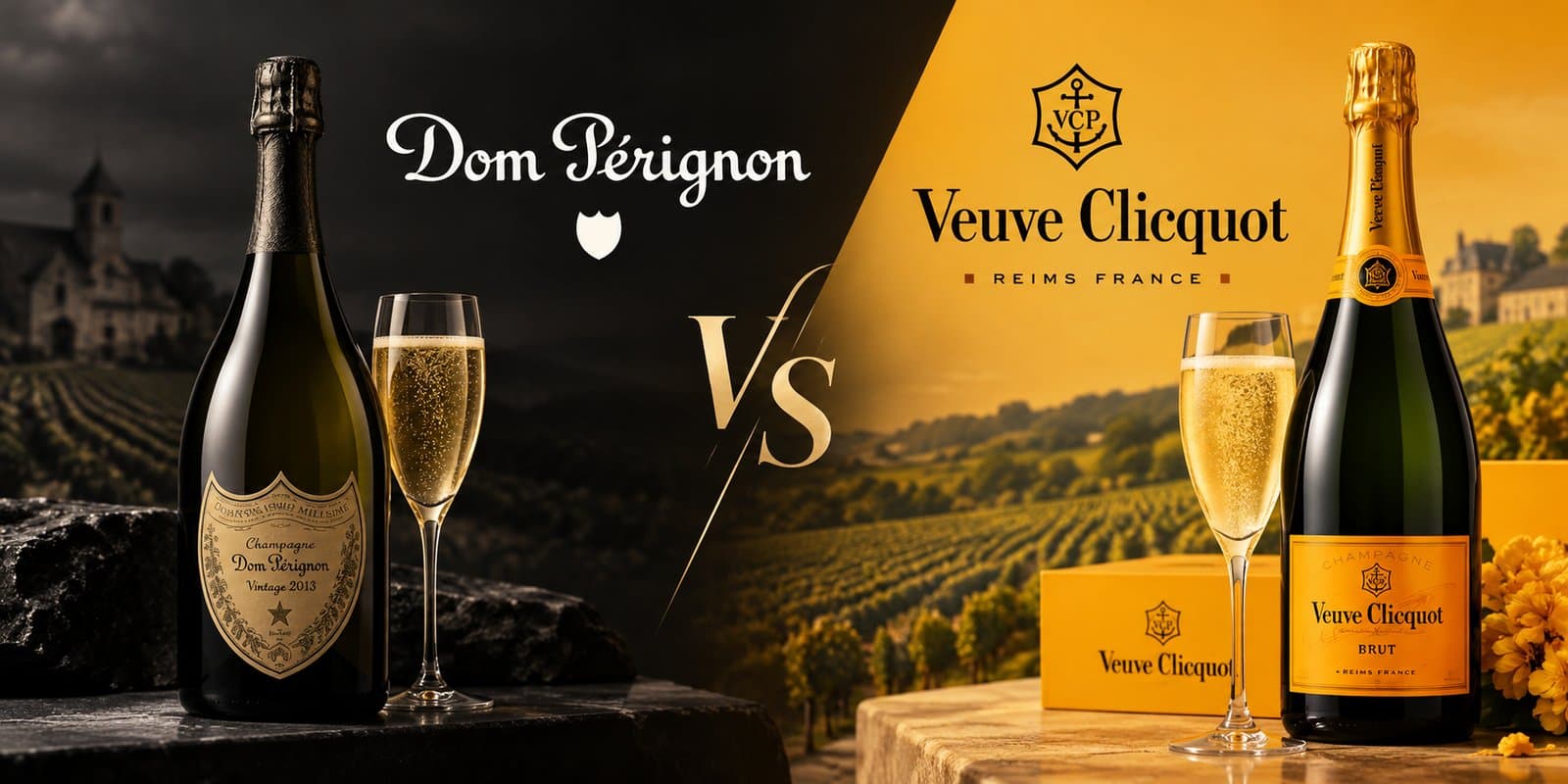
Dom Pérignon vs Veuve Clicquot: Which Champagne Is Better?
1
Oct
Admin 2 101

Dom Pérignon vs Veuve Clicquot: Which Champagne Is Better?

Standing in front of the champagne shelf, looking at a bottle of Veuve Clicquot for around $70 and a Dom Pérignon for $250 or more? You're not the first person to wonder whether the pricier one is really that much better.

These are two of the most famous names in champagne, and funnily enough, both belong to the same luxury group, LVMH. But they're built for very different moments and very different budgets. In this guide to Dom Pérignon vs Veuve Clicquot, we compare taste, price and production, put their bottles head-to-head, and help you pick by occasion, budget and taste. We'll also tell you honestly when Dom Pérignon is worth it, and when it isn't.

Short answer: Veuve Clicquot is the crowd-pleaser you can pop at almost any celebration, from weddings to a Friday night. Dom Pérignon is a rarer, more refined vintage champagne for milestones, luxury gifts and collecting, and it usually costs about three to four times as much. Both are excellent. The right pick depends on the moment.

Quick Comparison: Dom Pérignon vs Veuve Clicquot

Feature Dom Pérignon Veuve Clicquot
What it is Prestige champagne brand, first released by Moët & Chandon in 1936 Full champagne house, founded in Reims in 1772
Range Vintage only: Vintage, Rosé, Plénitude 2 Yellow Label Brut, Rosé, Rich, Vintage, La Grande Dame
Production Made only in exceptional years, from a single harvest Mostly non-vintage blends for a consistent style, plus vintage cuvées
Grapes Chardonnay and Pinot Noir only Pinot Noir-led, with Chardonnay and Meunier
Aging before release Roughly 8–10 years At least 3 years for non-vintage
House style Precise, creamy, mineral, layered Rich, fruity, toasty, full-bodied
Typical price (750ml) ~$250 to $500+ ~$60 to $200+
Best for Milestones, luxury gifts, collecting Weddings, parties, everyday and corporate gifting
Owned by LVMH LVMH

Champagne Basics: Vintage, Non-Vintage and Prestige Cuvée

A few label words make this whole comparison much easier to follow.

  • Non-vintage (NV): blended from several harvests so it tastes the same every year. Veuve Clicquot Yellow Label is the classic example.
  • Vintage: made from a single year's harvest, only when that year is good enough.
  • Prestige cuvée: a house's top bottle, made from its best grapes and aged much longer. Dom Pérignon is both vintage-only and a prestige cuvée. Veuve Clicquot's equivalent is La Grande Dame.
  • Brut: the sweetness level. It means dry, and it's what most people drink, including both brands' core bottles. (What is Brut champagne?)

So the real difference at the heart of Dom Pérignon vs Veuve Clicquot is vintage vs non-vintage: one brand bets everything on great years, the other on consistency. Our vintage vs non-vintage champagne guide goes deeper.

The History Behind Each House

Dom Pérignon: The Monk and the Myth

Dom Pérignon (say it dom peh-ree-NYON) is named after Dom Pierre Pérignon, a Benedictine monk and cellar master at the Abbey of Hautvillers in the late 1600s. There's a popular myth that he "invented" champagne. He didn't. Sparkling wine already existed. What he did was improve winemaking itself, especially the art of blending grapes from different vineyards, which raised quality across the whole Champagne region.

The champagne carrying his name came more than two centuries later. Moët & Chandon released the first Dom Pérignon, from the 1921 vintage, in 1936. It has been the name people picture when they think of luxury champagne ever since.

Veuve Clicquot: The Widow Who Changed Champagne

Veuve Clicquot (say it vuhv klee-KOH) was founded in Reims in 1772. Its legend is Barbe-Nicole Clicquot-Ponsardin, who was widowed at just 27 in 1805. "Veuve" means "widow" in French. At a time when women rarely ran businesses, she took charge and built one of the greatest houses in Champagne.

Did you know? Madame Clicquot invented the riddling table in 1816, which made champagne crystal-clear for the first time, and created the first known blended rosé champagne in 1818. Both techniques are still used across the industry today, including at Dom Pérignon.

The house registered its now-iconic Yellow Label in 1877, and it's still one of the most recognizable sights on any champagne shelf.

How They're Made: The Differences That Matter

Both are made in the Champagne region of France using the traditional method (méthode champenoise), where the second fermentation happens inside the bottle. The differences are in the grapes, the years and the time.

Grape Blend: What Makes Their Styles Different

Champagne is mostly made from three grapes, and each does a different job:

  • Chardonnay: freshness, elegance and citrus
  • Pinot Noir: body, structure and red-fruit power
  • Meunier: soft, juicy fruitiness

Dom Pérignon uses only Chardonnay and Pinot Noir, in close balance, with the blend shifting each vintage. That gives it both finesse and depth. Veuve Clicquot is Pinot Noir-dominant, with Chardonnay and Meunier. Its Yellow Label draws on 50–60 different vineyard sites and up to 45% older reserve wines, which is how it tastes so consistent from bottle to bottle. More in our champagne grape varieties guide.

The Veuve Clicquot Riddling Process

Riddling (remuage) is how champagne gets clear. After the second fermentation, dead yeast (lees) forms sediment in the bottle. The bottles are tilted neck-down and slowly turned over several weeks until the sediment collects in the neck. The neck is then frozen and the plug of sediment shoots out when the cap is removed (disgorgement).

The riddling process in four steps: lees settle, bottle tilted neck-down, sediment turned into the neck, then disgorgedStep 1Lees settleStep 2Tilt downStep 3Turn to neckStep 4Disgorge
Riddling moves yeast sediment (brown) into the neck so it can be removed. Madame Clicquot pioneered this in 1816.

Madame Clicquot pioneered this method, and today both houses, Dom Pérignon included, rely on it.

The Dom Pérignon Aging Process

Time is the biggest difference between these two. Dom Pérignon releases each vintage at peaks it calls "plénitudes":

  • Vintage (P1): released after roughly 8–10 years. This is the bottle most people buy.
  • Plénitude 2 (P2): the same vintage aged around 12–15+ years. Deeper, richer and more intense.
  • Plénitude 3 (P3): aged for decades. Extremely rare collector bottles.
Aging before release: Veuve Clicquot non-vintage vs Dom Pérignon P1, P2 and P30 yrs10 yrs20 yrs30 yrsVeuve Clicquot non-vintageVeuve Clicquot non-vintage: 3+ years before release3+ yearsDom Pérignon Vintage (P1)Dom Pérignon Vintage (P1): ~8–10 years before release~8–10 yearsDom Pérignon Plénitude 2 (P2)Dom Pérignon Plénitude 2 (P2): ~12–15+ years before release~12–15+ yearsDom Pérignon Plénitude 3 (P3)Dom Pérignon Plénitude 3 (P3): 30+ years before release30+ years
How long each champagne ages before release. Dom Pérignon's plénitudes are the same vintage released at later peaks.

Veuve Clicquot's non-vintage champagnes age for at least 3 years before release, which is generous for the category, while its vintage wines and La Grande Dame age longer. Even so, Veuve's style is built to be enjoyed on release, not cellared for decades.

Dom Pérignon vs Veuve Clicquot Taste

Taste is where these two start to feel like different drinks, not just different price tags.

What Does Dom Pérignon Taste Like?

Creamy, precise and layered. On the nose you'll find citrus, white flowers and a smoky, flinty edge that's a Dom Pérignon signature, with toasted brioche and roasted almond behind it. On the palate, crisp acidity and minerality come first, then honey and nuts as it opens up. The bubbles are fine and creamy rather than sharp, and the finish lingers and keeps changing as you sip.

What Does Veuve Clicquot Taste Like?

Bold, fruity and generous. Expect ripe apple, pear and citrus with toast and biscuit, and a hint of vanilla. Thanks to its Pinot Noir, it feels fuller and rounder in the mouth, with lively bubbles and a bright, satisfying finish. It's made to taste great the moment it's poured, and it has enough body to stand up to food.

Taste profile: Dom Pérignon vs Veuve Clicquot house styleDom PérignonVeuve ClicquotLowMediumHighBodyDom Pérignon body: 3/5Veuve Clicquot body: 4/5AcidityDom Pérignon acidity: 5/5Veuve Clicquot acidity: 3/5Ripe fruitDom Pérignon ripe fruit: 3/5Veuve Clicquot ripe fruit: 4/5ComplexityDom Pérignon complexity: 5/5Veuve Clicquot complexity: 3/5MineralityDom Pérignon minerality: 5/5Veuve Clicquot minerality: 2/5
Our tasting-style comparison on a 5-point scale. Individual vintages and bottles vary.

Can a Beginner Taste the Difference?

Often, yes, but it's subtle. Most people notice that Dom Pérignon feels smoother and more refined, while Veuve Clicquot is louder and fruitier. At a noisy party with a hundred guests, you probably won't notice much. The difference shows up when you sip slowly, with good glasses and good company. If you're new to champagne, our guide to what champagne tastes like is a great starting point.

Food Pairing

  • Dom Pérignon: oysters, caviar, lobster, scallops and other delicate seafood, where its minerality shines.
  • Veuve Clicquot: sushi, roast chicken, Brie, mushroom dishes, fried appetizers and charcuterie. Its fuller body handles bolder flavors.

See our champagne and food pairing guide for more.

Bottle by Bottle: Dom Pérignon vs Veuve Clicquot Head-to-Head

Brand comparisons only go so far. Here's how their actual bottles stack up.

Dom Pérignon Brut vs Veuve Clicquot Yellow Label Brut

These are the two bottles most people are really choosing between. It isn't a like-for-like fight, since one is a vintage prestige cuvée and the other a non-vintage house Brut, but it's the comparison shoppers make most.

Difference based on Dom Pérignon Brut (Vintage) Veuve Clicquot Yellow Label Brut
Type Vintage prestige cuvée Non-vintage house Brut
Style Precise, mineral, elegant Rich and structured
Main impression Finesse and complexity Power and generosity
Fruit profile Citrus, white peach Ripe apple, pear, yellow fruit
Secondary notes Brioche, roasted almond, smoky hints Toast, biscuit, vanilla
Body and bubbles Light-to-medium, fine creamy mousse Fuller, lively bubbles
Finish Long, evolving Bright, fruity
Aging before release Roughly 8–10 years At least 3 years
Typical price ~$250–$400 ~$60–$90
Best suited for Milestones, luxury gifts, collecting Parties, weddings, everyday gifts

Verdict: Dom Pérignon Brut is the better wine; Yellow Label is the better buy. Pouring for a crowd? Yellow Label wins easily. Marking one big moment? Dom Pérignon is worth the jump.

Dom Pérignon vs La Grande Dame (Prestige vs Prestige)

For a true like-for-like comparison, put Dom Pérignon against Veuve Clicquot's own prestige cuvée, La Grande Dame. Both are vintage-only, made in strong years and aged far longer than everyday champagne.

Dom Pérignon Vintage Veuve Clicquot La Grande Dame
Style Precise, mineral, elegant Rich, powerful, red-fruited
Grapes Chardonnay and Pinot Noir in balance Around 90% Pinot Noir
Typical price ~$250–$400 ~$150–$200+

Verdict: a close call that comes down to style. Choose Dom Pérignon for finesse and collector prestige, or La Grande Dame for depth and better value.

Dom Pérignon Rosé vs Veuve Clicquot Rosé

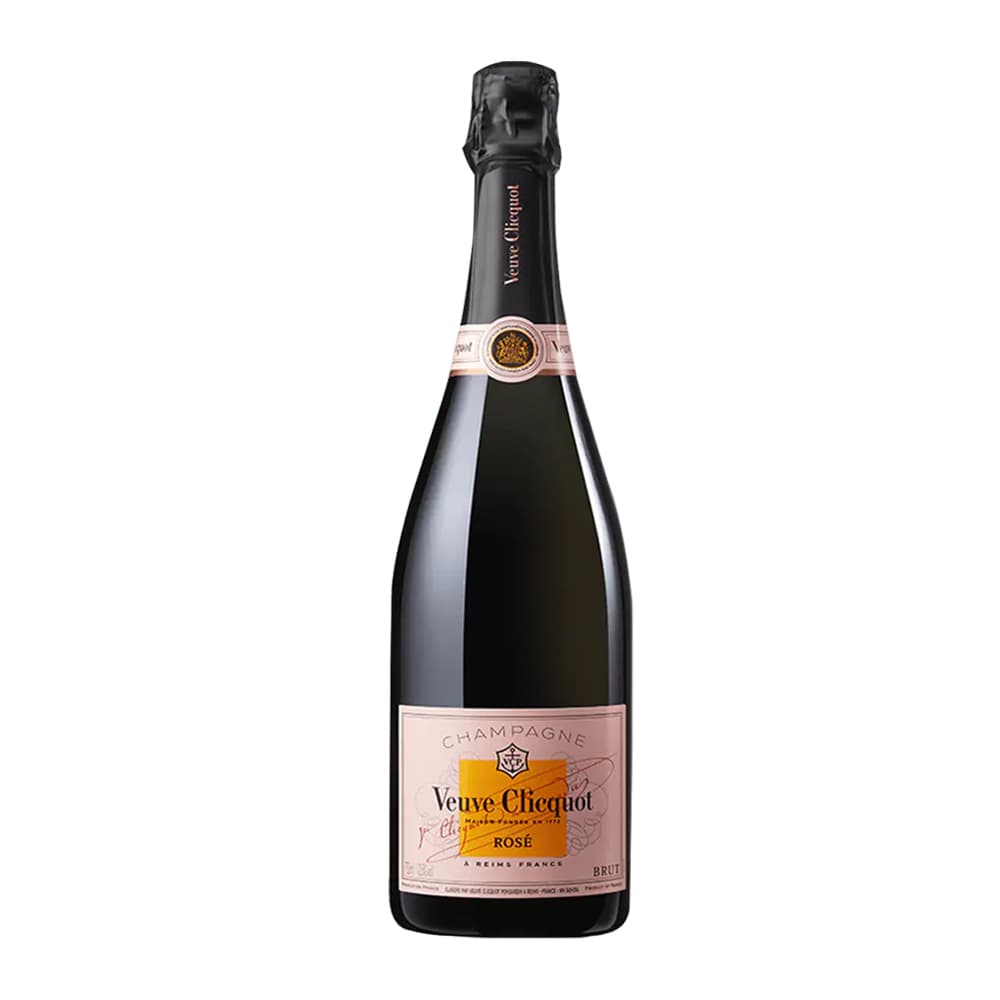
Veuve Clicquot Rosé (~$70–$100) is non-vintage, fruit-forward and soft, with red berry notes, perfect for brunch, showers and summer parties. Dom Pérignon Rosé (~$400–$500) is a vintage rosé with deeper, savory notes of red fruit, spice and cocoa, best for serious food pairings or a showstopper gift.

Dom Pérignon vs Veuve Clicquot Price

Champagne Type Typical price (750ml)
Veuve Clicquot Yellow Label Brut Non-vintage ~$60–$90
Veuve Clicquot Rosé Non-vintage ~$70–$100
Veuve Clicquot La Grande Dame Vintage prestige cuvée ~$150–$200+
Dom Pérignon Vintage Vintage ~$250–$400
Dom Pérignon Rosé Vintage ~$400–$500
Dom Pérignon Plénitude 2 (P2) Late-release vintage ~$500 to well over $1,000

Typical US retail prices. Prices change often and vary by vintage, retailer and state.

So, is Dom Pérignon more expensive than Veuve Clicquot? Yes, by a lot. Dom Pérignon's entry bottle costs roughly three to four times Veuve Clicquot's most popular champagne, and even Veuve's top cuvée, La Grande Dame, is usually cheaper than a standard Dom Pérignon.

Why Is Dom Pérignon So Much More Expensive?

  • Time: nearly a decade of aging ties up cellar space and money.
  • Selection: it's made only in great years, from the best grapes. Some years, there's simply no Dom Pérignon. The house has already confirmed there will be no 2023 vintage.
  • Limited supply and brand power: fewer bottles, high demand and one of the most famous names in wine.

What Is the Cheapest Bottle of Dom Pérignon?

The standard Dom Pérignon Vintage (Brut) in a 750ml bottle, typically starting around $250. The most recent release is the 2017 vintage, with the 2015 still easy to find. Older vintages and holiday promotions can sometimes bring the price down a little.

How Much Is a Bottle of Veuve Clicquot?

Veuve Clicquot ranges from about $60–$90 for the Yellow Label Brut to $70–$100 for the Rosé and $150 or more for La Grande Dame. For full breakdowns by size, style and vintage, see our Veuve Clicquot price guide and our Dom Pérignon price guide.

Is Dom Pérignon Worth the Extra Money?

Honestly? Sometimes yes, sometimes no.

When it's worth it:

  • Weddings and milestone anniversaries: it feels special, and people remember it.
  • Big achievements: a promotion, retirement, graduation or landmark birthday.
  • Luxury gifts: the name and gift box carry real impact.
  • Collecting: vintage bottles can be kept and enjoyed for years.

When it isn't:

  • Large, casual parties: the nuance gets lost in the noise.
  • Cocktails and mimosas: use something lighter (try our champagne cocktail ideas).
  • Tight budgets: you'd be stretching a lot for a difference many guests won't notice.

The smart middle option: Dom Pérignon is highly rated (its 2015 vintage scored in the mid-to-high 90s with major critics), but the quality gap with Veuve Clicquot's own prestige bottles is much smaller than the price gap. A Veuve Clicquot Vintage or La Grande Dame gets you "special occasion" quality without the top-tier price.

Which One Should You Choose?

Choose Dom Pérignon if:

  • You want crisp, refined champagne with layers that evolve in the glass
  • You're celebrating a wedding, a big anniversary or a major milestone
  • You want a gift that feels truly luxurious
  • You'd like a bottle to cellar or collect

Choose Veuve Clicquot if:

  • You prefer rich, fruity, full-bodied champagne
  • You're buying your first bottle of "real" champagne
  • You're hosting friends or serving a crowd
  • You want great quality at a friendlier price

Still Not Sure? Pick by Occasion

Occasion Our pick
Weekend brunch or bridal shower Veuve Clicquot Rosé
New Year's Eve or a big party Veuve Clicquot Yellow Label
Wedding toast for guests Veuve Clicquot Yellow Label
The couple's own first toast Dom Pérignon Vintage
Milestone anniversary dinner Dom Pérignon Vintage
Graduation or promotion Veuve Clicquot Vintage or La Grande Dame
Top client or VIP corporate gift Dom Pérignon (gift box)
Team or holiday corporate gifts Veuve Clicquot Yellow Label
Collecting or cellaring Dom Pérignon Vintage or P2
Under $100 Veuve Clicquot (more: best champagne under $100)

Weddings

Veuve Clicquot usually wins, and it's simple math. Weddings often mean dozens of bottles, and Yellow Label's price makes that realistic. Plan on roughly one bottle for every six to eight guests for a toast (here's how many glasses of champagne are in a bottle). A popular compromise: serve Veuve Clicquot to guests and save one bottle of Dom Pérignon for the couple. More ideas in our best champagnes for a wedding toast.

Investment and Collecting

Dom Pérignon is the clear pick. It's vintage-only, ages beautifully when stored properly, and older vintages and P2 releases tend to hold or grow in value. Veuve's non-vintage range is made to drink within a few years. See our guides to the best vintage champagne and the most expensive champagne.

Dom Pérignon or Veuve Clicquot: Which Makes the Better Gift?

Both make excellent gifts thanks to instant brand recognition, but they send slightly different messages.

Occasion / gift style Dom Pérignon Veuve Clicquot
Milestone anniversary The bottle that says "this moment mattered" A warm choice for yearly anniversaries
Wedding gift A keepsake bottle for a future anniversary A crowd-pleasing bottle to enjoy right away
Corporate gifting Top clients and VIPs Teams, clients and holiday gifting at scale
Birthday, housewarming, thank-you Big birthdays only The more versatile everyday luxury gift
Luxury impression Exclusive, rare, collectible Bold, iconic, instantly recognizable

Read more on why Dom Pérignon makes such a good gift and why Veuve Clicquot is a good champagne gift.

What to Pair With Your Champagne Gift

One thoughtful extra turns a great bottle into a memorable gift:

  • Anniversary: Dom Pérignon + dark chocolate. Its slight bitterness makes the champagne's creamy, layered taste stand out. (See our wine and chocolate pairings guide.)
  • Wedding gift: Dom Pérignon + a pair of crystal champagne flutes for the couple's first toast.
  • Birthday or brunch: Veuve Clicquot Rosé + strawberries or macarons. The berry notes match the fruit beautifully.
  • Housewarming: Veuve Clicquot Yellow Label + salted nuts or a small cheese board, easy for the host to open and share.
  • Promotion or graduation: Veuve Clicquot + a handwritten note. The bottle says "congratulations"; the note says "I'm proud of you."

Want it done for you? Our Dom Pérignon and Veuve Clicquot gift sets pair each bottle with chocolates, flutes and gourmet treats. For more ideas, see what to pair with champagne as a gift and the best anniversary champagne.

How to Serve and Store Them

  • Temperature: chill both to 45–50°F (7–10°C), about 3 hours in the fridge or 30 minutes in an ice bucket with water. (Why temperature matters.)
  • Glass: a tulip or white wine glass shows off the aromas better than a narrow flute. (Champagne glass types.)
  • Opening: tilt the bottle, hold the cork firmly and turn the bottle slowly. You want a soft sigh, not a loud pop. (How to open champagne.)
  • Pouring: give Dom Pérignon a few minutes in the glass to open up; Veuve Clicquot is ready straight from the fridge.
  • Storage: keep bottles cool, dark and on their side. Enjoy non-vintage within a few years; vintage Dom Pérignon can rest much longer.

Final Verdict: Is Dom Pérignon Better Than Veuve Clicquot?

In pure quality terms, Dom Pérignon is the more complex, more age-worthy champagne. But "better" depends on what you need.

If you want a crowd-pleasing bottle you can pour often and share generously, Veuve Clicquot is the smarter pick. If you're marking a once-in-a-while moment and want something unforgettable, Dom Pérignon is worth the extra cost. And if you want to land in between, La Grande Dame or a Veuve Clicquot Vintage is a smart move.

In one line: Veuve Clicquot is the champagne you drink often. Dom Pérignon is the one you remember.

Frequently Asked Questions(FAQ's)

Which is better, Dom Pérignon or Veuve Clicquot?

Dom Pérignon is more refined, complex and age-worthy, making it better for milestones, luxury gifts and collecting. Veuve Clicquot is the better value for weddings, parties and everyday celebrations.

What is the difference between Dom Pérignon and Veuve Clicquot?

Dom Pérignon is a vintage-only prestige champagne made from Chardonnay and Pinot Noir in exceptional years and aged around 8–10 years. Veuve Clicquot is a full champagne house known for consistent, Pinot Noir-led non-vintage blends, topped by its prestige cuvée, La Grande Dame.

Is Dom Pérignon more expensive than Veuve Clicquot?

Yes. Dom Pérignon Vintage typically costs about $250–$400, while Veuve Clicquot Yellow Label costs about $60–$90. Even La Grande Dame is usually less expensive than Dom Pérignon.

What does Dom Pérignon taste like compared to Veuve Clicquot?

Dom Pérignon is creamy, mineral and layered, with citrus, brioche, almond and a long finish. Veuve Clicquot is bolder and fruitier, with apple, pear, toast and a fuller body. Both are dry (Brut).

Is Veuve Clicquot a good champagne?

Yes. It's a well-reviewed, consistent champagne from one of Champagne's most historic houses, and one of the most popular first champagnes for beginners. More in our guide: Is Veuve Clicquot good champagne?

What makes Dom Pérignon so special?

It's made only in exceptional years, aged for nearly a decade, and every bottle comes from a single vintage. That scarcity and patience set it apart. See: Is Dom Pérignon good champagne?

Which champagne is best for a wedding: Dom Pérignon or Veuve Clicquot?

Veuve Clicquot for serving guests, since you'll need many bottles. Dom Pérignon for the couple's own toast or as a wedding gift.

Are Dom Pérignon and Veuve Clicquot owned by the same company?

Yes. Both are owned by LVMH (Moët Hennessy Louis Vuitton), which also owns Moët & Chandon, Krug, Ruinart and Mercier.

What is the cheapest bottle of Dom Pérignon?

The standard Dom Pérignon Vintage (Brut) in a 750ml bottle, typically starting around $250.

How much does Veuve Clicquot cost?

Yellow Label Brut typically costs $60–$90, the Rosé $70–$100, and La Grande Dame from around $150.

Is Dom Pérignon a vintage champagne only?

Yes. Every Dom Pérignon comes from a single harvest year, and the house skips years that don't meet its standards. There is no non-vintage Dom Pérignon.

What's the difference between Veuve Clicquot Yellow Label and La Grande Dame?

Yellow Label is Veuve Clicquot's non-vintage everyday Brut (~$60–$90). La Grande Dame is its vintage prestige cuvée, made mostly from Pinot Noir in strong years and aged much longer (~$150–$200+). It's Veuve's answer to Dom Pérignon.

Is Veuve Clicquot sweet or dry?

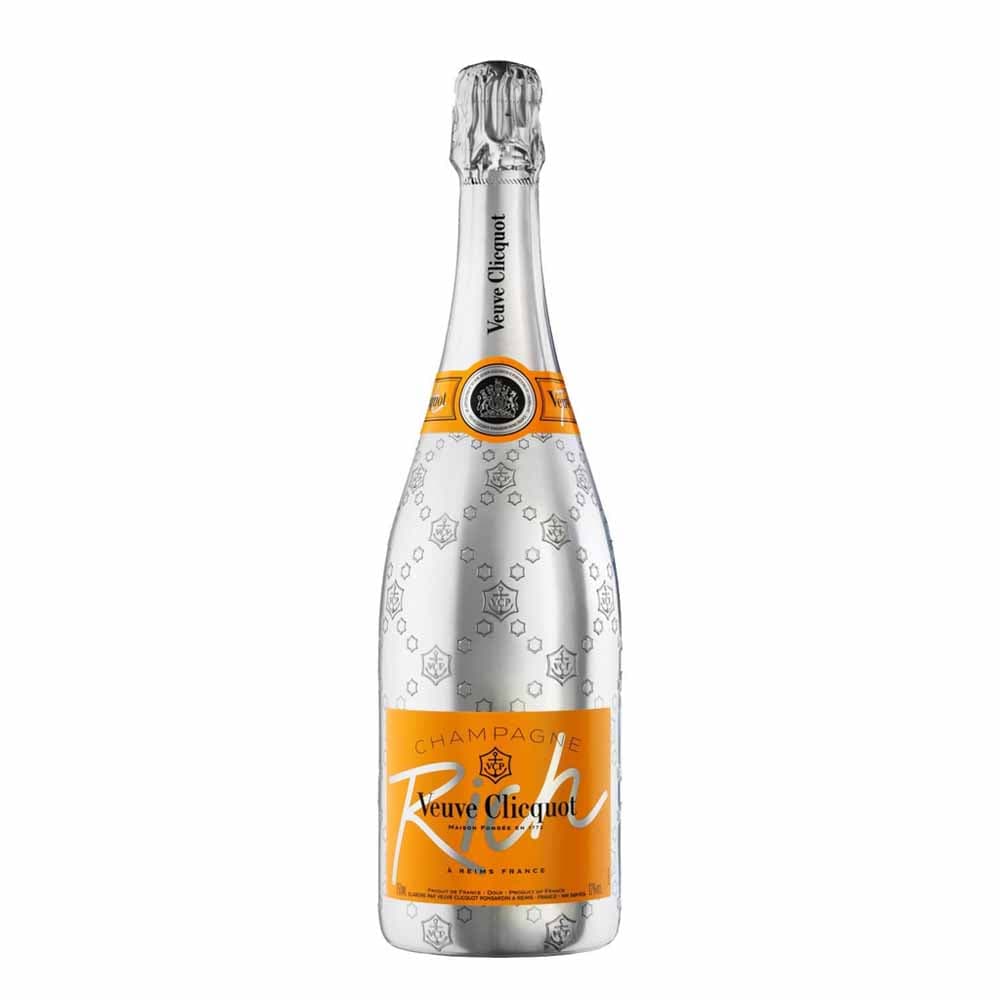
Yellow Label is Brut, so it's dry. If you prefer sweeter champagne, Veuve Clicquot Rich is designed for that and works well in cocktails.

How long can you store Dom Pérignon and Veuve Clicquot?

Non-vintage Veuve Clicquot is best within a few years of purchase. Dom Pérignon can age for 10 years or more when stored cool, dark and on its side.

Conclusion: Pick the Bottle That Fits the Moment

There's no wrong choice between Dom Pérignon and Veuve Clicquot, only the right bottle for the moment. Choose Veuve Clicquot when you want reliable, crowd-pleasing champagne to share. Choose Dom Pérignon when the occasion deserves something rare and unforgettable. Whichever you pick, the best champagne is the one shared with the right people.

Please drink responsibly. You must be 21+ to purchase alcohol.

What is Wine? A Simple Guide to Understanding Wine
30
Sep
Abott Megha 2 49

What is Wine? A Simple Guide to Understanding Wine

Wine can seem complicated when you first encounter words like vintage, appellation, tannin, varietal and terroir. But at its heart, wine is remarkably simple: wine is an alcoholic beverage made by fermenting grape juice.

The grape has the sugar, water, acids, colour and many of the flavour and aroma compounds that eventually shape the finished wine. During fermentation, yeast converts the grape sugars into alcohol, while different winemaking choices, maturation and the place where the grapes are grown add further layers of flavour, aroma and texture to wine.

Whether you are a complete beginner, a student, someone new to drinking wine, or simply checking the facts for dietary, religious or health reasons, this guide explains what wine is, what is actually in it, how it is made, and how a humble bunch of grapes becomes the drink in your glass.

What is wine? At a glance

  • Wine is an alcoholic drink made from fermented grape juice.
  • It is about 85% water and usually 8–15% alcohol.
  • Most wine comes from Vitis vinifera grape varieties such as Cabernet Sauvignon and Chardonnay.
  • The main types are red, white, rosé, orange, sparkling, dessert and fortified.
  • A wine's taste is shaped by the grape, where it grows, the vintage and the winemaker.

What Is Wine Made From?

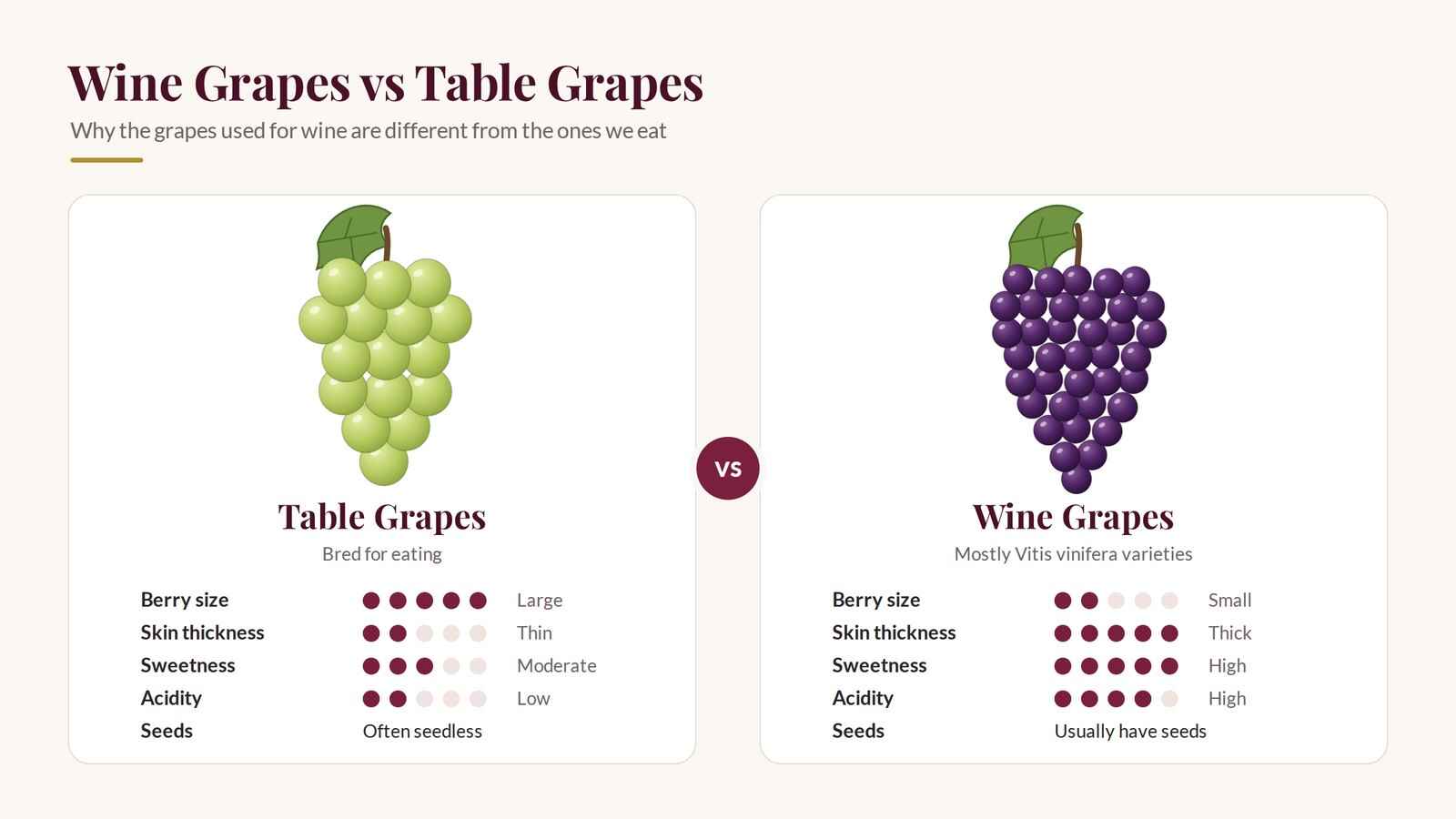
The short answer is grapes. Specifically wine grapes, most commonly from the species Vitis vinifera, a species first domesticated for winemaking in the South Caucasus and Near East. Wine grapes are different from the table grapes we eat. They tend to be smaller, sweeter and more acidic, with thicker grape skins and seeds, making them particularly suitable for winemaking.

During fermentation, yeast consumes the natural sugars in grape juice and produces alcohol and carbon dioxide. That fermented grape juice becomes wine. The finished wine has alcohol, acids, residual sugar (in wines with sweetness), aromas, flavours, and other compounds such as tannins contributing to its character.

For red wines, the juice is fermented together with the dark grape skins, which give the wine its colour and tannins. For white wines, the juice is usually separated from the skins before fermentation, which is why they are lighter in colour and have little or no tannin.

Can wine be made from other fruits? Yes. Apples, plums, berries and pomegranates can all be fermented into "fruit wines," which are usually named after the fruit (plum wine, for example). Drinks like rice wine (sake) and barley wine are brewed from grains, so they are closer to beer. When people simply say "wine," they almost always mean wine made from grapes, and in many countries the word is legally reserved for it.

Wine grapes vs table grapes: wine grapes are smaller, sweeter and thicker-skinned, with seeds
Side-by-side illustration of a table grape and a wine grape (size, skin thickness, seeds, sugar)

What Are Wine Grapes?

They are varieties specifically suited to producing wine, with thousands of grape varieties existing around the world. Almost all of the wine we drink comes from varieties of Vitis vinifera; a few other species, and hybrids between them, are also grown, mainly in North America.

Cabernet Sauvignon, Chardonnay, Pinot Noir, Riesling, Sauvignon Blanc and Syrah are just a few well-known examples. Each grape variety has its own natural characteristics. Cabernet Sauvignon, for instance, is known for its deep colour, firm tannins and blackcurrant flavours, while Riesling is prized for its high acidity and floral, citrus notes.

But the final wine is also influenced by climate, soil, vineyard practices, winemaking and ageing, in other words, where the grapes are growing and how they are handled. That is why the same grape can taste remarkably different when grown in different parts of the world. Grapes growing in warm, sunny climates tend to give riper, fuller wines, while those from cooler climates are often lighter and fresher, with higher acidity.

Variety or varietal? A variety is the grape itself, for example the Chardonnay vine. A varietal is the finished wine made mostly from one variety, for example a bottle labelled "Chardonnay."

What's Actually in a Glass of Wine?

If you are checking the facts, for health, dietary or religious reasons, it helps to know what wine is actually made of once it is finished. Most of it is simply water from the grape. The rest is what gives wine its strength, taste and character.

Component Typical amount What it does
Water About 85% Comes from the grape juice; no water is usually added
Alcohol (ethanol) 8–15% ABV in most table wines; about 15–22% in fortified wines Warmth, body, and preservation
Residual sugar Under 4 g/L in dry wines; 45 g/L or more in sweet wines, and far higher in some dessert wines Sweetness
Glycerol Usually about 5–15 g/L A by-product of fermentation that adds a smooth, rounded feel
Acids Tartaric, malic, lactic and citric Freshness, balance and stability
Phenolics Mostly from grape skins, seeds and stems Colour (anthocyanins) and tannins
Aroma compounds Tiny amounts, but hundreds of them The fruity, floral, spicy or savoury smells in wine
Other compounds Minerals (potassium, magnesium), sulfites, dissolved CO₂ Stability and, in sparkling wines, bubbles

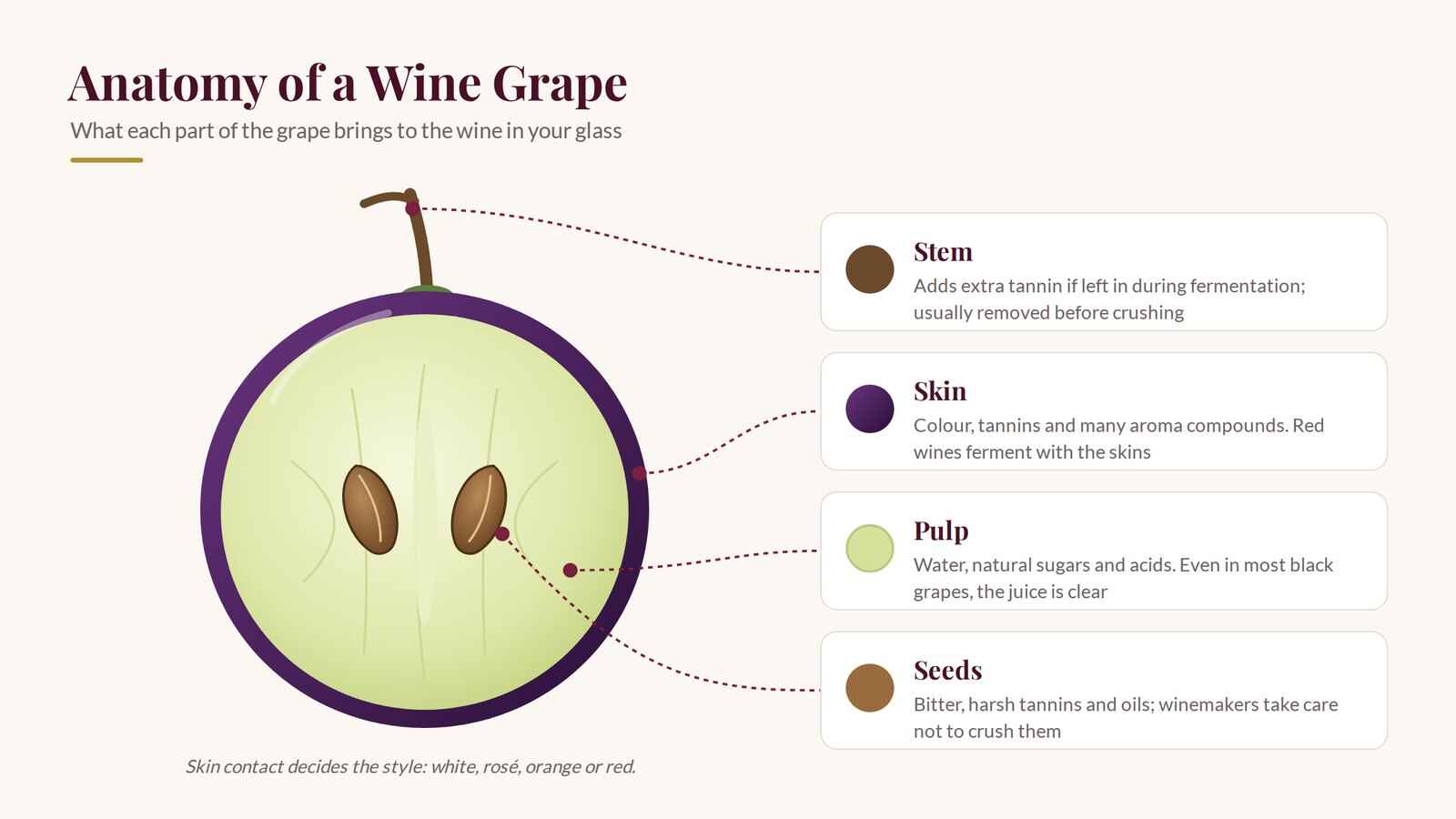
A quick note on the grape itself: the pulp holds most of the water, sugar and acid, while the skin holds most of the colour, tannin and aroma compounds. That is why skin contact matters so much in deciding whether a wine becomes red, white, rosé or orange.

Anatomy of a wine grape: skin gives colour and tannin, pulp gives sugar, water and acid
Cross-section diagram of a wine grape labelling skin, pulp, seeds and stem with what each contributes

How Is Wine Made?

Every winery has its own methods, but most wine follows the same basic journey from vineyard to bottle.

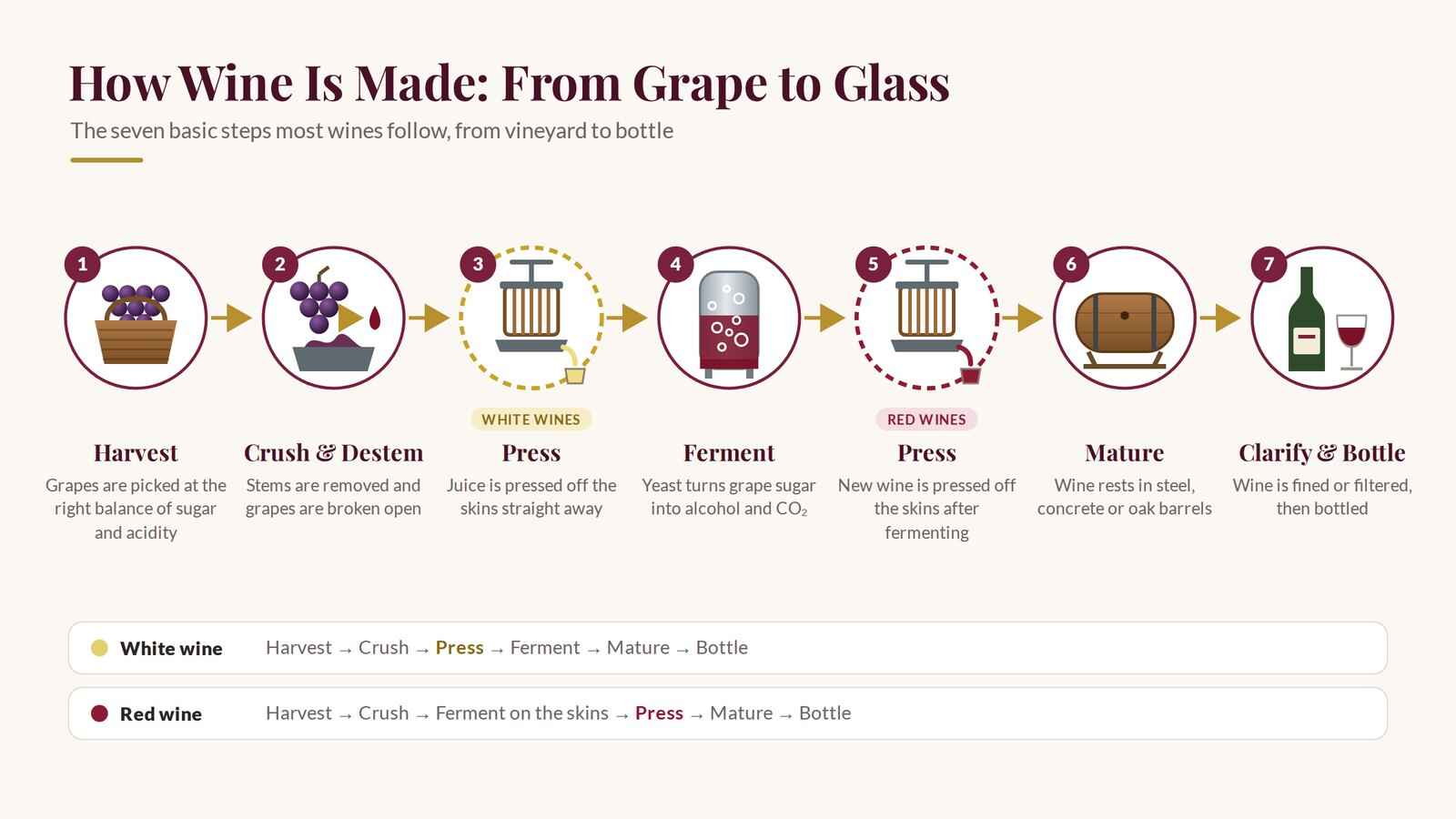
  1. Harvest. Grapes are picked when they reach the right balance of sugar and acidity. In the Northern Hemisphere that is usually August to October; in the Southern Hemisphere, February to April.
  2. Crush and destem. The grapes are separated from their stems and gently broken open to release the juice.
  3. Press (white wines first). For white wines, the juice is pressed off the skins straight away. For red wines, the skins stay in the juice so they can release colour and tannin.
  4. Ferment. Yeast converts the grape sugars into alcohol and carbon dioxide. This usually takes one to three weeks. Stopping fermentation early leaves natural sweetness in the wine.
  5. Press (red wines). After fermentation, red wines are pressed to separate the new wine from the skins and seeds.
  6. Mature. The wine rests in stainless steel, concrete or oak barrels for a few months to several years. Oak can add notes of vanilla, toast and spice.
  7. Clarify and bottle. The wine is settled, fined or filtered to make it clear and stable, then bottled. Some wines continue to age and improve in the bottle.

Sparkling wines go through a second fermentation that traps carbon dioxide as bubbles, and fortified wines like Port and Sherry have a grape spirit added.

How wine is made: harvest, crush, press, ferment, mature, clarify and bottle
Grape-to-glass process infographic showing the 7 steps above

A Brief History of Wine

Wine is one of the oldest drinks made by humans. The earliest evidence of winemaking, dating to around 6000 BCE, comes from present-day Georgia, where wine was fermented in large clay vessels called qvevri, a method still used today. The oldest known winery, around 6,100 years old, was found in a cave in Armenia.

From the Caucasus and the Near East, winemaking spread to ancient Egypt, Greece and Rome. The Greeks honoured wine through the god Dionysus and the Romans through Bacchus, and Roman expansion planted vineyards across much of Europe, including regions that are still famous today. In the Middle Ages, monasteries preserved and refined viticulture, especially in France and Germany. From the 16th century onward, European settlers carried vines to the Americas, South Africa and later Australia and New Zealand.

Wine has also long played a role in religion. It is part of the Christian Eucharist and the Jewish Kiddush, while Islam and some other faiths prohibit alcohol, which is one reason many people look up exactly what wine contains before deciding whether to drink it.

Types of Wine

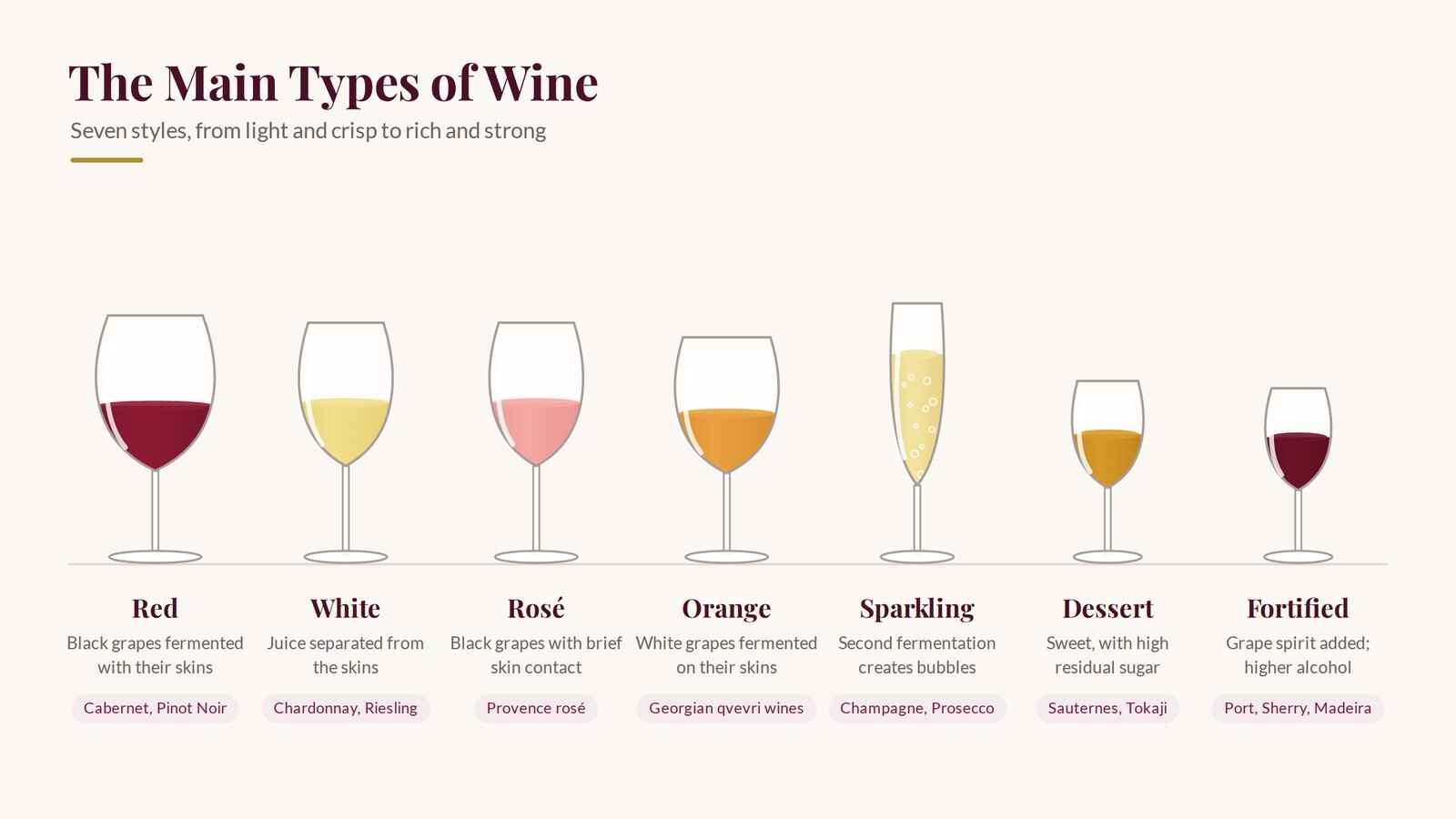
Most people know wine through its main types. Here is a quick overview:

Type of wine How it's made What to expect
Red wine Black grapes fermented with their skins Red to purple colour, tannins, red and black fruit flavours
White wine Usually white grapes, juice separated from the skins Pale colour, fresh acidity, citrus, apple and stone fruit flavours
Rosé wine Black grapes with brief skin contact Pink colour, light and fruity
Orange wine White grapes fermented with their skins, like a red Amber colour, some tannin, dried fruit and nutty notes
Sparkling wine A second fermentation traps carbon dioxide as bubbles Fizzy, lively and refreshing
Dessert / sweet wines Fermentation leaves noticeable residual sugar Honeyed, rich and luscious
Fortified wine A grape spirit is added Higher alcohol, often richer or sweeter (Port, Sherry, Madeira)
Types of wine: red, white, rosé, orange, sparkling, dessert and fortified
Visual chart of the 7 wine types with a glass of each showing colour

For a deeper look at each style, read our complete guide to the different types of wine:

How Wine Is Classified

Wine can be classified in several ways, including colour, sweetness, carbonation, alcohol level, grape variety, blend, vintage and geographical origin. But we mainly know or hear of red wine, white wine, rosé wine, and sparkling wine. Other information on the label often depends on the wine's country of origin and its local labelling regulations.

Main classification What it means Examples
By colour Based primarily on whether wine is made from black or white grape varieties Red, white, rosé
By style Describes the overall style of the wine Still, sparkling, fortified, sweet
By sweetness Based on the amount of residual sugar or sweetness in the final wine Dry, off-dry, medium-sweet, sweet
By grape variety The wine is identified by the principal grape used Chardonnay, Pinot Noir, Cabernet Sauvignon
Single-varietal wine Made predominantly from one grape variety Chardonnay, Sauvignon Blanc
Wine blend Made by combining two or more grape varieties Bordeaux blend, GSM blend
By vintage Identified by the year in which the grapes were harvested 2022, 2023, 2024
Non-Vintage (NV) Made by blending wines from different harvest years Many Champagnes
By geographical origin Identified by where the grapes were grown, often under specific regional rules Bordeaux, Chianti, Napa Valley
By appellation A legally defined geographical designation with rules defining production AOC, DOC/DOCG, AVA
By alcohol level Can also be broadly described according to alcohol content or wine ABV Low, moderate or high-alcohol wines

An important point for beginners in wine: these classifications can overlap. For example, a bottle can be a dry, red, still, single-varietal Cabernet Sauvignon from Napa Valley, with a 2022 vintage. The label brings these pieces of information together, helping you understand what is in the bottle and where it comes from. Don't miss: A Simple Guide to Understanding Any Wine Label

Four of these classifications deserve a closer look.

Single-Varietal Wine

A single-varietal wine is made predominantly from one grape variety and is usually named after it, such as a Chardonnay or a Sauvignon Blanc. "Predominantly" is the key word: the minimum share of the named grape is set by local law, so a single-varietal wine may legally contain a little of other grapes.

Country / region Minimum % of the named grape
European Union (France, Italy, Spain, Germany, etc.) 85%
Australia 85%
New Zealand 85%
South Africa 85%
United States (federal rule) 75%
Oregon, USA 90% for most varieties

Single-varietal wines are a great way for beginners to learn how individual grape varieties taste.

Wine Blend

A wine blend is made by combining two or more grape varieties. Winemakers blend to build balance and complexity, pairing one grape's structure with another's fruit, aroma or softness.

Famous examples include the Bordeaux blend (typically Cabernet Sauvignon and Merlot, often with Cabernet Franc and others) and the GSM blend (Grenache, Syrah and Mourvèdre) from the Southern Rhône and beyond. Blending is not a sign of lower quality; many of the world's most celebrated wines are blends. You may also see a blend called a cuvée, especially in Champagne, which is usually champagne grape variety of Chardonnay, Pinot Noir and Pinot Meunier.

The Origin of the Term "Vintage"

The word vintage comes from the French vendange, meaning "grape harvest," which traces back to the Latin vindemia, from vinum (wine) and demere (to take away), literally "taking the grapes." In English, the spelling shifted under the influence of vintner, the old word for a wine merchant.

Grapes ripen once a year, so each harvest produces one vintage. On a wine label, the vintage is simply the year the grapes were harvested. It matters because weather changes every year. A warm, sunny season can produce riper, fuller wines, while a cool or rainy one may give lighter, more acidic wines from the very same vineyard. Because harvests happen at opposite times of year in the two hemispheres, a 2026 Argentine wine was picked around March, while a 2026 French wine was picked around September. In exceptional years, Champagne houses release vintage bottles; see the best vintage Champagne years.

Non-Vintage (NV) Wine

A non-vintage (NV) wine is made by blending wines from different harvest years. Producers do this to create a consistent house style year after year, smoothing out the differences between good and difficult seasons.

Non-vintage is especially common in Champagne and other sparkling wines, as well as in some fortified wines such as many Sherries and Ports. NV does not mean lower quality; it simply means the wine's character comes from blending across years rather than from a single harvest.

The Taste of Wine: The Main Components

Different types of wine can have the following components in varying degrees. Various wine terms and descriptors are used to identify these characteristics as they appear in different wine styles.

1. Flavours

Flavours are the taste impressions you experience when drinking wine, such as citrus, apple, berries, peach, spices or chocolate. They come from the grape variety, winemaking, ageing and the environment where grapes grow.

2. Aromas

Aromas are the smells you notice in the wine, and they can range from fresh fruit and flowers to herbs, spices, vanilla or toast. Much of what we perceive as "flavour" actually comes through our sense of smell.

3. Sweetness

Sweetness comes from residual sugar, which is the natural grape sugar left in the wine after fermentation. Wines can range from dry, having little or no perceptible sweetness, to sweet wines with noticeably higher levels of sugar.

4. Acidity

Acidity gives wine its freshness and creates a mouth-watering sensation, much like lemon or green apple. It helps balance sweetness and is particularly important in making wine feel lively rather than flat. Wine is quite acidic, typically around pH 3 to 4, similar to many fruit juices.

5. Tannins

Tannins are naturally occurring compounds found mainly in grape skins, seeds and stems, and they create a drying or slightly grippy sensation in the mouth. They are especially noticeable in red wines and can soften as the wine ages.

6. Alcohol

Alcohol gives wine warmth and contributes to its body and texture. Most table wines contain roughly 8 to 15% alcohol by volume. There are wines that fall outside this range.

7. Body

Body describes how light or heavy a wine feels in your mouth. Imagine the difference between skimmed milk and cream. Alcohol, tannins, sweetness, acidity and other components all contribute to the wine's overall weight and texture.

8. Finish

The finish is the lasting flavour and sensation that remain in your mouth after you swallow or spit the wine. A long finish, often found in complex wines, means the wine's flavours and sensations linger on in a pleasant way. The short finish of a simple wine disappears relatively quickly.

How to Taste and Serve Wine

You don't need special training to taste wine well. Try these four steps with your next glass:

  1. Look. Tilt the glass against a white background and note the colour and depth.
  2. Swirl. Gently swirl the wine to release its aromas.
  3. Smell. Take a short sniff and think about what you notice: fruit, flowers, spice, oak?
  4. Sip. Let the wine coat your mouth, then notice its sweetness, acidity, tannin, body and finish.

The right glass helps too; see our guide to different types of wine glasses. Serving temperature makes a big difference to how a wine tastes:

Wine style Serving temperature
Sparkling wine 6–10°C (43–50°F)
Light whites and rosé 7–10°C (45–50°F)
Fuller whites (e.g. oaked Chardonnay) 10–13°C (50–55°F)
Light reds (e.g. Pinot Noir) 12–14°C (54–57°F)
Fuller reds (e.g. Cabernet Sauvignon) 15–18°C (59–64°F)
Sweet and fortified wines 8–16°C, depending on style

Short on time? Here is the best way to chill wine fast. For bubbly, see our guide to serving Champagne at the right temperature.

For more tips, read How to Serve Wine and How to Drink Wine Proficiently.

For food, a simple rule works well: match light wines with light dishes and fuller wines with richer dishes. High-acid whites cut through creamy or oily food, while tannic reds pair well with red meat. Our food and wine pairing guide covers this in detail.

Major Wine Regions Today

Wine is now produced on almost every continent. Today both historic and emerging wine regions contribute to the global wine landscape.

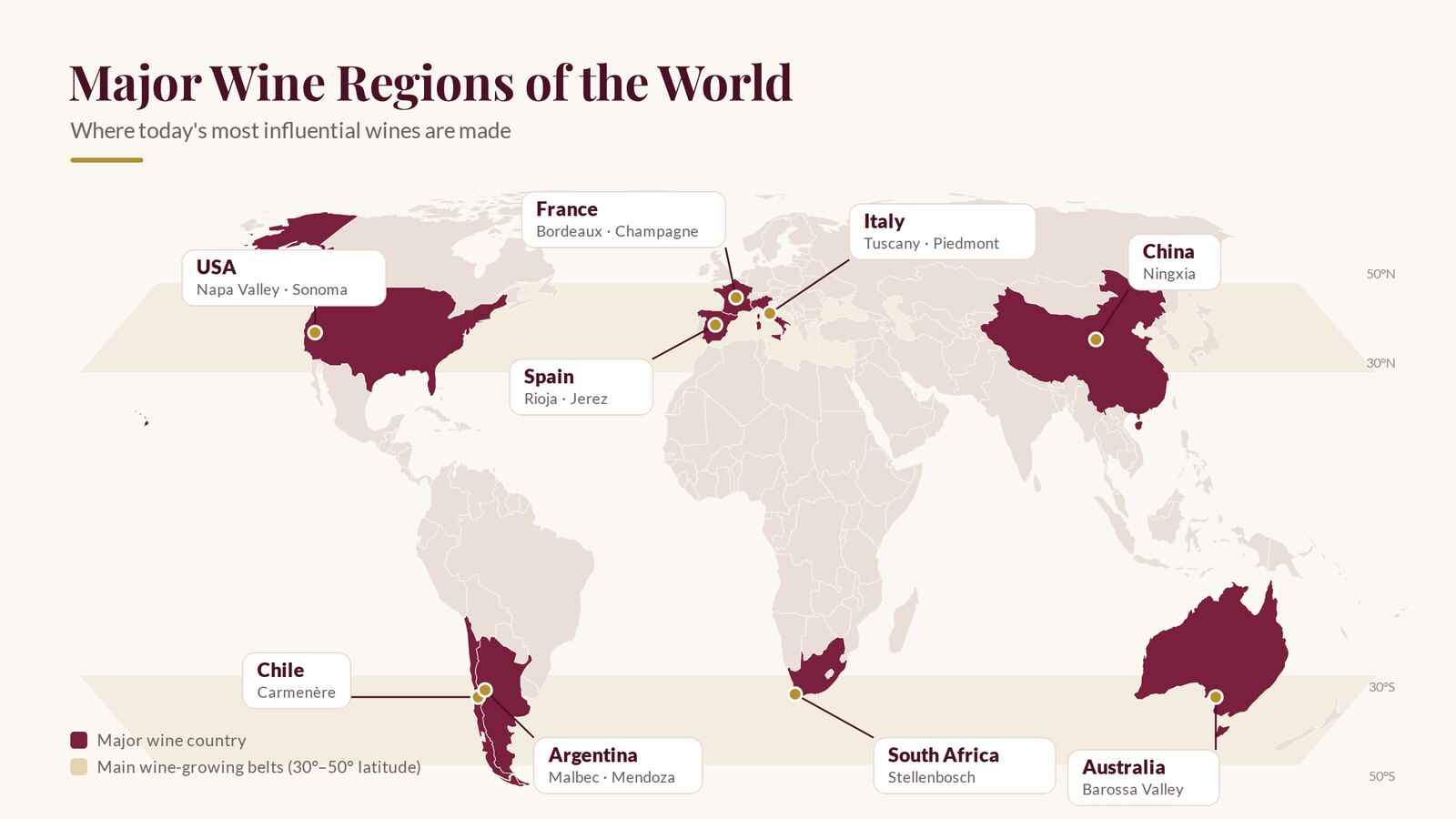
Map of major wine regions: France, Italy, Spain, USA, China, Australia, Chile, Argentina and South Africa
World map of the major wine regions listed below

France remains one of the world's most influential wine countries, home to regions such as Bordeaux, Burgundy, Champagne, Rhône, Loire and Alsace. French wine culture has had an enormous influence on grape varieties, winemaking and wine terminology worldwide.

Italy is one of the world's most diverse wine countries. Italy's wine regions stretch from Piedmont and Veneto in the north to Tuscany, Sicily and Puglia in the south. It is particularly known for its extraordinary range of indigenous grape varieties. See our pick of the best Italian wines.

Spain offers a remarkable combination of old vineyards, native grapes and varied climates. Rioja, Ribera del Duero, Priorat, Rías Baixas and Jerez are among its best-known wine regions.

USA: The United States has a major wine industry, with California leading production. Regions such as Napa Valley, Sonoma and the Central Coast don't really need an introduction. Oregon and Washington also produce distinctive wines. Explore famous wineries in Napa Valley and the best California white wines.

China has one of the largest vineyard areas in the world and is one of the fastest-rising names in wine. Ningxia, at the foot of the Helan Mountains, has earned international recognition, alongside regions such as Shandong, Xinjiang and Yunnan. Cabernet Sauvignon is the country's leading red grape.

Australia is known for regions including Barossa Valley, Margaret River, Yarra Valley and Hunter Valley. Grapes like Shiraz, Chardonnay and Cabernet Sauvignon are among its important varieties for Australian wine.

Chile's long, narrow geography creates a fascinating range of climates. Cabernet Sauvignon, Carmenère, Sauvignon Blanc and Chardonnay are among its notable wines.

Argentina is particularly famous for Malbec, especially from Mendoza, but also produces excellent Cabernet Sauvignon, white wines from Torrontés and other varieties.

South Africa combines an old winemaking history with a modern, dynamic industry. Stellenbosch, Swartland, Constantia and Hemel-en-Aarde are among its notable regions, producing everything from Chenin Blanc to Cabernet Sauvignon and Pinot Noir.

What Is an Appellation? (AOC, DOC and AVA)

If wine labels sometimes seem like a geography lesson, there is a reason. An appellation system identifies wines according to their geographical origin. Depending on the regional laws, it may also specify permitted grape varieties, production methods and other requirements.

Take a look at a few examples to understand these systems within the well-known wine regions.

  1. France – AOC (Appellation d'Origine Contrôlée): The system links a wine's characteristics to a grape variety, a defined geographical area and recognised production practices. France also has IGP category wines, which are generally simpler and more fruit-forward.
  2. Italy – DOC (Denominazione di Origine Controllata): A traditional designation within the country's protected-origin system. Italy also has DOCG (a higher category than DOC) and IGT (simple, fruity) categories.
  3. USA – AVA (American Viticultural Area): A defined grape-growing area with distinguishing geographical or climatic features. The US currently has hundreds of established AVAs, with California containing the largest number.

These systems help communicate where a wine comes from and, in different ways, the rules and traditions associated with that place.

Why Wine Makes a Great Gift

Wine gifts are particularly thoughtful because they can be personal without being overly complicated. Great wine gifts can mark a birthday, anniversary, dinner invitation, promotion or celebration in a special way. You can choose a wine based on someone's favourite grape, region, occasion or even a memorable place they have travelled to.

And unlike many gifts, wine can become part of an experience: opened over dinner, shared with friends or saved for a special occasion. Whether you choose one of the best red wines for gifts or a white wine gift, wine rarely misses. If you're buying for someone who is new to wine, our guide to the Best Wine for Beginners can help you choose a bottle that is approachable and easy to enjoy.

Also read: 10 Reasons Customers Choose Wine & Champagne Gifts for Meaningful Gifting

Frequently Asked Questions About Wine

What is wine in simple words?

Wine is an alcoholic drink made by fermenting grape juice. Yeast turns the natural sugar in grapes into alcohol and carbon dioxide.

What is wine made of?

Finished wine is about 85% water, plus alcohol (usually 8–15%), acids, glycerol, a little or a lot of sugar depending on style, and small amounts of colour, tannin and aroma compounds from the grapes.

Does all wine contain alcohol?

Yes, by definition wine contains alcohol, usually around 8% to 15% ABV for table wines and more for fortified wines. "Non-alcoholic" or "alcohol-free" wines are made as wine and then have most of the alcohol removed; many still contain a trace amount, so check the label if you avoid alcohol completely for religious, health or personal reasons.

Is wine vegan or vegetarian?

Not always. Some wines are clarified ("fined") with animal-derived products such as egg whites, milk protein, gelatin or isinglass (from fish). Look for wines labelled vegan or vegetarian if this matters to you.

What are sulfites in wine?

Sulfites are compounds produced naturally in small amounts during fermentation and often added in small quantities to protect wine from spoilage. Many countries require labels to state "contains sulfites," as some people are sensitive to them.

How long does wine last once opened?

Most still wines stay fresh for about 3–5 days once opened if you recork them and keep them in the fridge; sparkling wines lose their bubbles within 1–3 days. Learn how to store an open bottle of wine and how to tell if wine has gone bad.

Is wine gluten-free?

Yes. Wine is made from grapes, not grain, so it is naturally gluten-free. Any traces from winemaking materials are generally far below the levels that affect most people with coeliac disease, but anyone highly sensitive should check with the producer.

How many calories are in a glass of wine?

A standard 150 ml (5 oz) glass of dry wine at around 12–13% ABV contains roughly 120–130 calories, mostly from the alcohol. Sweet and fortified wines contain more. See Wine and Calories Made Easy and Calories in Red Wine for a full breakdown.

Is wine good for your health?

Wine contains alcohol, and health authorities such as the World Health Organization advise that no amount of alcohol is risk-free. Older claims that moderate wine drinking protects the heart are now widely debated. If you choose to drink, drink moderately, and speak to a doctor if you have health concerns.

How long does it take to make wine?

Fermentation takes one to three weeks, but most wines then mature for several months before bottling. Some fine wines are aged for years in barrel and bottle before release.

What does "NV" mean on a wine label?

NV stands for non-vintage: the wine is a blend of wines from more than one harvest year, which is common in Champagne.

Can wine be made from fruits other than grapes?

Yes. Fruit wines are made from apples, berries, plums and more. But when people say "wine" without qualification, they almost always mean wine made from grapes.

What is the difference between red and white wine?

Red wine is fermented with dark grape skins, giving it colour and tannins; white wine is usually made without skin contact. See our detailed guide, Red Wine vs White Wine.

Final Thoughts

So, what is wine? At its simplest, it is fermented grape juice. But that simple definition only tells part of the story. Wine is shaped by grape variety, climate, soil, vintage, human decisions, tradition and time. It can be a product of agriculture, an expression of place, a great pairing with food and, for many people, a way of connecting with culture and other people.

Whether you're just beginning to explore wine or already know your Cabernet from your Chardonnay, there is always another bottle, region or grape waiting to tell you something new. And perhaps that is the most interesting thing about wine: it is simple enough to begin with, but complex enough to keep discovering.

How Much Alcohol Is in Wine? Understanding ABV & Factors
20
Sep
Abott Megha 2 62

How Much Alcohol Is in Wine? Understanding ABV & Factors

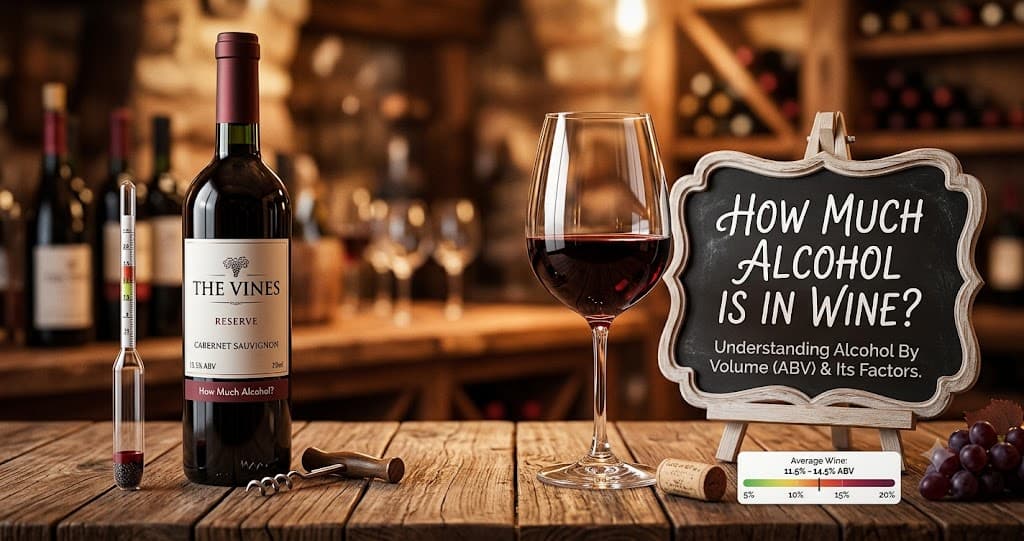
Wine is one of the world’s most popular and loved alcoholic beverages, yet many people wonder about its alcohol content, and what if I tell you that, I’ve even been asked, "Is wine alcohol?" Whether you’re choosing a bottle for dinner, understanding how much wine it takes to get drunk, monitoring your alcohol intake for health reasons, or comparing different wine styles, understanding wine ABV (alcohol by volume) can help you make informed choices.

In this guide we’ll explain alcohol by volume in wine, average wine alcohol content, how much alcohol is in a glass of wine, and which wines have the highest ABV.

What is the Alcohol Percentage in Wine?

Wine ABV stands for Alcohol By Volume. It measures the percentage of pure alcohol contained in a wine.

For example:

  • A wine with 12% ABV contains 12% pure alcohol by volume.
  • A wine with 15% ABV contains 15% pure alcohol by volume.

The alcohol volume of wine is determined during fermentation, when yeast converts grape sugars into alcohol. Wines of all origins typically display the wine ABV clearly, making it easy to compare different bottles. Different types of wine have different levels of alcohol.

Is Wine Alcohol?

Yes, wine is an alcoholic beverage made by fermenting the grape juice. During fermentation, naturally occurring sugars in the grape juice are converted into ethanol (alcohol), which gives wine its alcoholic potency. Therefore, wine alcohol content varies depending on the grape variety, climate, winemaking style, and fermentation process.

Average Wine Alcohol Content

The average alcohol content of table wine typically ranges from 9% to 15% ABV.

Wine Style Average ABV
Sparkling Wine 10% to 12.5%
White Wine 10% to 14%
Rosé Wine 11% to 13.5%
Red Wine 12% to 15%
Fortified Wine 15% to 22%

Understanding alcohol percent wine helps consumers choose wines that match their preferences and tolerance levels.

White Wine Alcohol Content

White wine alcohol content generally falls between 10% and 14% ABV.

  • Riesling: 8% – 12% ABV
  • Sauvignon Blanc: 11.5% to 13.5% ABV
  • Pinot Grigio: 11% to 13% ABV
  • Chardonnay: 12% to 14.5% ABV

Cool-climate white wines often have lower alcohol levels, while warm-climate styles tend to have higher ABV. This is directly related to the natural sugar content in the grapes, which is higher in warm-climate grapes and more moderate in cool-climate grapes.

Red Wine Alcohol Content

Red wine alcohol content is usually higher than many white wines because black grapes mainly grow in warm-climate regions, often achieving a higher degree of ripeness and sugar concentration.

Typical red wine ABV levels include:

  • Pinot Noir: 12% to 14.5% ABV
  • Merlot: 13% to 14.5% ABV
  • Cabernet Sauvignon: 13.5% to 15% ABV
  • Syrah/Shiraz: 13.5% to 15.5% ABV
  • Zinfandel: 14% to 16% ABV

Red wine ABV is typically higher, giving red wines a fuller body and more texture.

How Much Alcohol Does Wine Have?

The answer to this depends on the one style as the serving size. Most table wines contain between 11% to 14% alcohol by volume in wine. A standard 750ml bottle of wine at 13% ABV contains approximately 97.5ml of pure alcohol. The exact wine alcohol can vary considerably between producers, vintages, and wine styles. Keeping an eye on the wine label for ABV will help you pick the right bottle every time. Since alcohol also hides calories in it, knowing it well will ensure that every time you pour a glass, you know your wine and calories right.

How Much Alcohol Is in a Wine Glass?

A standard serving of wine is 150 ml (5 ounces). The total amount of alcohol in a glass of wine will depend on the ABV of the wine you choose to drink.

For a wine with 13% ABV:

  • Wine volume: 150 ml
  • Alcohol content: 13%
  • Pure alcohol: 19.5 ml

This means a standard glass of wine typically contains roughly the same amount of alcohol as a regular beer or a standard spirit measure.

How Much Alcohol Is In Wine by Size?

The amount of alcohol changes depending on the serving size.

Wine Serving Size Wine ABV Pure Alcohol
125 ml 13% 16.25 ml
150 ml 13% 19.5ml
175 ml 13% 22.75 ml
250 ml 13% 32.5 ml
750 ml Bottle 13% 97.5 ml

Understanding how much alcohol is in wine by size helps consumers track alcohol consumption more accurately. For instance, lighter and low-alcohol styles are often considered the best wines for women.

What Is Considered High ABV Wine?

A high ABV wine generally contains 14% alcohol or more. Take a look at the high ABV wine style examples:

  • Zinfandel
  • Amarone della Valpolicella
  • Australian Shiraz
  • Châteauneuf-du-Pape
  • Napa Valley Cabernet Sauvignon wines

These wine styles have a fuller body, more texture, and concentrated flavors, all of which make them more complex too.

Which Wine Has the Most Alcohol by Volume?

For naturally fermented wines, some of the highest ABV levels can reach 15% to 16.5%.

Examples include:

  • Amarone della Valpolicella
  • Zinfandel
  • Shiraz from warm climates
  • Grenache-based wine

However, fortified wines contain significantly higher alcohol.

Examples include:

  • Port: 19% to 22% ABV
  • Sherry: 15% to 22% ABV
  • Madeira: 17% to 22% ABV

So if you're asking, "Which wine has the most alcohol by volume?" fortified wines are generally the strongest wine category available.

Does Higher ABV Mean Better Quality?

This is not at all true! The quality of wine depends on many factors—wines with low or high ABV can be top tier or even fall in the segment of unacceptable quality.

A higher wine ABV does not automatically indicate better quality. Alcohol should be balanced with:

  • Acidity
  • Fruit concentration
  • Tannins
  • Structure
  • Overall balance and harmony

Many outstanding wines are only 11% to 12.5% ABV, while some powerful wines exceed 15% ABV. The best wines achieve balance across all their aspects rather than simply maximizing alcohol content.

Final Thoughts

Wine alcohol varies widely depending on grape variety, region, climate, and winemaking style. Most wines typically have between 11% to 14% ABV, while wines with even higher alcohol can exceed 15%. Having a clear understanding of wine ABV, the alcohol content of wine, and the alcohol percentage in wine can help you compare different styles, estimate alcohol intake, and choose wines that suit your preference and occasion.

Whether you’re trying to drink wine proficiently, enjoying a crisp, citrusy Sauvignon Blanc, a bold Cabernet Sauvignon, or a fortified wine like Port or Sherry, knowing how much alcohol is in wine allows you to appreciate every glass more responsibly.

Different Types of Rosé Wine: A Simple Guide to Styles, Sweetness, and More
18
Sep
Abott Megha 2 51

Different Types of Rosé Wine: A Simple Guide to Styles, Sweetness, and More

Rosé is no longer just the pretty pink wine we reach for on a sunny afternoon or on a girls’ day out. From pale, bone-dry Provence rosé to rich Tavel, fruity White Zinfandel, and even sparkling rosé, there is a surprisingly wide world of pink wine to explore.

So, how do you know which one to choose? The easiest way is to understand the different types of rosé wine and how they differ in sweetness, body, flavor, and style. Once you know what you like, choosing a bottle becomes much easier.

What is rosé wine?

How is rosé wine made is what differentiates it from red wine. Rosé is made from red grapes, but the grape skins have much less contact with the juice than they would during red wine production. This gives rosé its beautiful pink color while retaining the freshness we often associate with white wine. The color can range from the palest onion skin and peach to salmon, pink, and deeper ruby with an orange hue. And color doesn't necessarily tell you how sweet the wine will be. Rosé can be dry, off-dry, sweet, still, or sparkling. That's what makes the category so interesting. If you're new to the category, you may also want to read our guide on what is rosé wine.

The Main Styles of Rosé

There is no official list that defines every rosé in the world. Instead, to understand rosé wine, one can look at grape variety, region, production method, and sweetness. Here are some of the most useful rosé wine types to know from around the world:

1. Provence Rosé: pale, dry, and elegant

This is probably the style most people picture when they think of modern rosé. Usually pale in color, Provence rosé is typically dry, fresh, and light to medium-bodied. You can expect fresh flavors of strawberry, citrus, peach, herbs, and sometimes a subtle mineral character. Made from varieties such as Grenache, Cinsault, Syrah, and Mourvèdre. It is wonderfully versatile with food. Think grilled fish, salads, Mediterranean vegetables, or seafood, or simply pair this rosé with a plate of fresh cheese on a balmy day.

2. Garnacha Rosado: fruity and lively

Spain's Garnacha Rosado offers a more fruit-forward expression of rosé. Strawberry, raspberry, watermelon, and citrus flavors are common, often balanced by refreshing acidity. It is particularly good with Spanish food. Tapas, seafood, paella, and grilled vegetables are easy matches.

3. Pinot Noir Rosé: delicate and fresh

Pinot Noir can make an elegant, lighter style of rosé with bright acidity and delicate red-fruit flavors. Expect strawberry, raspberry, cherry, and floral notes, sometimes with a subtle earthy character. If you usually enjoy lighter white wines or elegant Pinot Noir, this can be a beautiful rosé to try. Best food pairings would be tossed salads, prosciutto & melon, and open veggie canapés, for more you can read this Pinot Noire and food pairing guide.

4. Mourvèdre Rosé: fuller and more savory

Mourvèdre gives rosé more weight and structure. It is especially associated with southern France and Bandol, where the wines can be quite serious and age-worthy. You may find flavors of red berries, peach, herbs, spice, and savory notes. This is a great choice when you want something that can stand up to grilled fish, lamb, barbecue, or richer Mediterranean dishes.

5. Sangiovese Rosé: bright and refreshing

Italy's Sangiovese can produce rosé with lively acidity and flavors of strawberry, sour cherry, citrus, and red fruit. Italian rosé, often called Rosato, can be made from several local grape varieties and may have more colour and savoury character than the delicate Provence style. These wines are particularly enjoyable with Italian food, from pizza and pasta to grilled vegetables and cheese platters.

6. Tavel: a rosé with more body

Tavel, from the Rhône Valley in France, is one of the more distinctive rosé styles. It tends to be deeper in color and fuller-bodied than a typical pale Provence rosé. It can have ripe red-fruit flavours, herbs, and savoury complexity, making it particularly good with substantial food. So if you thought rosé is always light and delicate, Tavel may change your mind.

7. White Zinfandel – fruity and sweet

White Zinfandel is one of the best-known sweeter styles of rosé, particularly in the United States. It is generally off-dry to medium-sweet, with flavors of strawberry, watermelon, and other ripe fruit. It is very different from the dry, pale rosés associated with Provence. If you enjoy a softer, sweeter, fruitier wine, this may be your style. White Zinfandel can be a superb match for light desserts like meringues, macaroons, or Madeline cakes.

8. Moscato Rosé: sweet, fragrant, and sometimes sparkling

If you are looking for a sweeter rosé, Moscato Rosé is one to know. It is often highly aromatic, with flavors of strawberry, orange, and other ripe fruit. Depending on the wine, it can be still or lightly sparkling, with refreshing acidity balancing the sweetness. This makes it particularly good with spicy food, fruit tarts, or simply as an easy-drinking aperitif. And yes, white moscato and pink moscato (rosé moscato) are different.

9. Rosé Champagne: pink with bubbles

Yes, rosé can sparkle too. Rosé Champagne combines the freshness and structure of Champagne with red-fruit flavors and the visual appeal of its pretty pink color. It can be made using the traditional Champagne grapes and is produced either by blending or through the saignée approach, depending on the producer and style. And if you love bubbles, don't stop at Champagne. Rosé Prosecco is another popular sparkling style known for its easy-drinking nature.

What are the 7 classifications of rosés?

There isn't a universally recognized system of exactly seven official classifications of rosé. However, rosé can be broadly understood through categories such as dry, off-dry, sweet, sparkling, still, light-bodied, and fuller-bodied styles. For everyday wine buying, you should simply know what rosé wine tastes like. It is more useful to think about the wine's sweetness level, body, acidity, grape variety, and origin than to memorize a complicated, fixed classification system.

What is Brut Rosé?

Brut Champagne is a dry sparkling wine. "Brut" refers to the wine's relatively low level of residual sugar, which is often not recognizable on the palate. So a Brut rosé Champagne, despite its pink color and fruity aromas, feels typically dry rather than sweet on the palate. Rosé Champagne labelled Brut is therefore a good choice if you want bubbles, a red-fruit character, and freshness without the noticeable sweetness.

What is the sweetest type of rosé wine?

There isn't one universal answer, but Moscato Rosé and sweeter styles of White Zinfandel are among the rosés commonly found at the sweeter end of the spectrum. Always check the label or producer's description rather than relying on color. Sweet wine labels typically show clear information on grams per liter of sugar, which indicates the sweetness level, allowing you to choose accordingly. A deep pink rosé isn't automatically sweeter, and a very pale rosé isn't automatically dry.

What is the most popular rosé wine?

Provence-style rosé is arguably the most recognizable dry rosé style internationally. It is particularly famous among people looking for a pale, elegant, dry, and refreshing rosé wine. White Zinfandel has also been enormously popular, particularly in the United States amongst circles of sweet wine lovers. Popularity of a wine style, however, depends on the market and whether we're talking about a particular region, grape, brand, or style.

Which rosé should you choose?

Here are some of the best and most unique rosé wine bottles to try based on your taste preference:

Final Thoughts

And that is perhaps the best thing about rosé: there isn't just one style. So there’s something for every mood and occasion. From a pale glass of Provence on a warm afternoon to a fuller Tavel with dinner or a celebratory rosé Champagne, the world of pink wine is far bigger and more interesting than it first appears.

Next time you pick up a bottle, don't just ask, "Is it rosé?" Ask: "What kind?"

Champagne Cocktail Recipe: Elegant Champagne & Holiday Cocktails
13
Sep
Abott Megha 2 54

Champagne Cocktail Recipe: Elegant Champagne & Holiday Cocktails

Champagne? A drink that has always resonated with elegance and celebration. Beyond raising a celebratory toast, champagne is also known to create the most visually stunning, classy, and refreshing cocktails. Flavors from fruit peels or juices, bitters, liqueurs, and other spirits combine well with the fizz and flavors of Champagne. There are some surprisingly versatile and popular cocktails that can be created with champagne.

So, whether you’re looking to create cocktail drinks with champagne, figure out the best champagne for cocktails, or (already) sketch out your festive Xmas cocktails list for a holiday party, this guide explores everything you need to know about making crowd-pleasing and delicious champagne-based drinks. 

What Are Champagne Cocktails?

What Are Champagne Cocktails

Champagne cocktails are mixed drinks that use champagne as the primary ingredient or cocktail base. Champagne-based drinks feel light and aromatic and get further enhanced with the addition of citrus or berry notes and liqueurs. Champagne can feature as a finishing to top up the drink or can even be the base where you start building the drink with champagne. Its lively bubbles impart a refreshing texture to the drinks, which makes them perfect for summer sipping and holiday parties alike. There are many different types of champagne out there, but first understand what is champagne and choose the next perfect bottle for your soirée.

Why Champagne Works Well in Cocktails

Why Champagne Works Well in Cocktails

Cocktail drinks with champagne feel lighter and more refreshing than many spirit-based cocktails. The best standpoint of champagne is its high and bright acidity. Champagne blends well in sparkling wine-based cocktails, as the effervescence lightens and elevates the drink without ever making them feel heavy or overtly pleasant. The fine bubbles of champagne add a crisp character to the cocktails, further enhancing the aromas, while also making other flavors like berries, bitters, or fruits shine through subtly. Another advantage is versatility. Champagne pairs effortlessly with so many different ingredients, such as orange liqueur, cranberry or orange juice, elderflower, or fresh fruits. You create a wide range of sparkling cocktails.

Champagne vs. Sparkling Wine in Cocktails

Champagne vs. Sparkling Wine in Cocktails

You may find "champagne" being used as a generic term in general or in the case of sparkling wine cocktails. But a sparkling wine can really be called champagne only if it hails from the Champagne region of France. Many cocktail recipes feature the use of sparkling wines other than champagne. The choice totally depends on what pleases your pocket and palate. High-quality sparkling wines like Cava or more budget-friendly Prosecco form the base of many famous sparkling wine-based cocktails. Knowing the difference between Champagne vs Prosecco can help you choose the perfect sparkling wine for your next cocktail party. Understanding sparkling wine types, flavors, and pairings can help you pick the right one for your next cocktail.

Best Champagne for Cocktails

The best champagne for cocktails is usually a Brut Champagne, which is dry and crisp. Dry sparkling wines balance off other pleasant ingredients like fruit juices or syrups and help maintain freshness in the drink. Brut Champagne cocktails pair well with various cuisines because champagne and food pairing is already a time-tested way of successfully combining wine and food. Brut Champagne, Brut sparkling wine, and dry Prosecco are excellent options. Extremely pleasant styles of sparkling wine should be avoided, as they can take away from the other natural flavors in the drink. The goal is to choose a champagne such as Billecart-Salmon that complements the cocktail rather than overpowering it.

Classic Champagne Cocktail Recipe

It is an ever-pleasing, elegant, and simple cocktail that is still popular in the world of modern-day craft cocktails. The classic champagne cocktail is really the most classic one; it dates back to the 1800s. Building the perfect classic champagne cocktail is really easier than it sounds. Let's take a peek into the ingredients and the method of making this stylish classic champagne cocktail

Ingredients:

  • 1 sugar cube
  • 2–3 dashes aromatic bitters
  • 10 ml cognac or brandy
  • Chilled Champagne
  • Lemon twist garnish

Method:

Place the sugar cube in a Champagne flute and add bitters. Pour in the cognac and gently top up with champagne. Garnish with a lemon twist and voila!

The best champagne for this cocktail recipe is Pommery Grand Cru Royale - with its deftly balanced citrus, green pear flavors, subtle brioche-like aromas, and brut style, Pommery Champagne allows aromatic bitters to shine softly upon the cocktail's otherwise crisp nature, elevating the experience with mild warmth from Cognac.

Quick & Easy Champagne Cocktail Recipes

Cocktail Main Ingredients Flavor
Classic Champagne Cocktail Champagne, bitters, sugar cube, cognac Elegant, lightly sweet
Mimosa Champagne, orange juice Bright, citrusy
Bellini Champagne, peach purée Fruity and soft
Poinsettia Champagne, cranberry juice, orange liqueur Festive and tart
Kir Royale Creme de cassis, Champagne Luxurious berry notes, sophisticated
French 75 Champagne, gin, lemon juice, sugar Citrusy and refreshing

Popular Cocktail Drinks with Champagne

Many famous cocktails use champagne as a central ingredient. The Mimosa is one of the most well-known brunch drinks, simply combining champagne with fresh orange juice for a bright and refreshing cocktail. Perfect citrus buzz to wake you up on a holiday morning. Stir up a mimosa with Perrier-Jouet Blanc de Blancs Champagne, a champagne style made using white grapes only. The shiny acidity perks up Mimosa’s already vibrant persona with its purest expression of Chardonnay, offering minimalistic luxury alongside notes of white flowers, citrus peels, and toast.

The Bellini is made with peach purée and sparkling wine—another classic favorite. Blend fresh peach purée with Moet & Chandon Brut Imperial Champagne. An iconic mainstay of champagne cocktails, Moet & Chandon offers subtle underpinnings of berry fruit & sourdough, letting the fresh peach notes get enhanced as persistent yet soft bubbles gingerly rise to the top of the champagne flute.

Meanwhile, the French 75 blends gin, lemon juice, sugar, and champagne. Billecart-Salmon Brut Reserve Champagne, a champagne as classic and luxe as the French 75 cocktail, is the model pick for this recipe. Billecart-Salmon has a balanced appeal where flavors elevate the cocktail’s sweet-sour tone. The faultless marriage of botanicals and citrus makes this cocktail irresistible.

Poinsettia Cocktail Recipe

Another widely popular Xmas champagne cocktail is the poinsettia cocktail. This champagne-based drink is named after the classic red holiday flower; it’s bright and festive to look at and incredibly easy to make. Here’s how you can make a poinsettia in just minutes:

Ingredients

  • 90 ml Champagne
  • 30 ml cranberry juice
  • 15 ml orange liqueur
  • Orange peel or cranberries for garnish

Method:

Pour cranberry juice and orange liqueur into a Champagne flute. Top with chilled champagne and garnish with an orange peel or fresh cranberries. Henriot Brut Souverain Champagne is a vibrant yet quietly luxurious champagne for this Christmas champagne cocktail. Henriot Brut Souverain Champagne showcases soft green fruit, a mild floral bouquet, and baguette-like notes, which skillfully blend with Poinsettia’s festive personality without losing champagne’s own delicate balance.

Easy Champagne Cocktail Variations

Champagne cocktails are easy to build and also customizable according to seasonal flavors. Simple variations can include adding fresh berries, citrus slices, or flavored liqueurs. For example, adding elderflower liqueur creates a floral sparkling cocktail, while pomegranate juice adds depth and layers of color. Using fresh or dried herbs such as rosemary or thyme can add aromatic complexity and a great aesthetic. These variations make Champagne cocktails especially popular for festive occasions and themed gatherings.

Best Fruits and Flavors That Pair with Champagne

Fruits and Flavors That Pair with Champagne

Champagne pairs well with a variety of fruits and fresh ingredients. Citrus fruits such as orange, lemon, and grapefruit enhance the wine’s acidity and brightness. Berries, including raspberry, strawberry, and cranberry, bring natural sweetness and vibrant color. Stone fruits such as peach and apricot create softer, fruit-forward cocktails. Herbal notes like mint, basil, and rosemary complement the sparkling wine and add aromatic depth.

Why Champagne Cocktails Are Perfect for Holidays

Champagne cocktails are quintessential for holidays, as they are easy to make and seamlessly blend Champagne's prestige with modern cocktail fervor. The celebratory sense offered by champagne’s pop of the cork signals joy and excitement of the season. Along with being stylish, Champagne cocktails are quite functional for the hosts—high acidity and bright flavors help cleanse the palate between rich holiday food offerings like heavy roasts and creamy seafood dishes. Champagne cocktails are incredibly food-friendly, making them a foolproof choice for diverse holiday menus across different cultures. The effervescence of champagne helps release aromas of spirits and other seasonal ingredients like rosemary sprigs, cranberries, and citrus peels, creating an intriguing mix of flavors and a festive cocktail experience.

Best Cocktails for Christmas Parties

Christmas parties are all about fun, and champagne cocktails can add fizz and elegance to them. Best cocktails for Xmas parties are Poinsettia, Bellini, and Mimosas—all of them are fizzy and light and add a bright festive cheer to the holiday tables without feeling heavy or too potent. Holiday aesthetics come alive as champagne cocktails allow you to imaginatively use fruit peels, red berries, rosemary sprigs, or pomegranate to give your personal touch and make the cocktails vibe with your holiday party perfectly.

Holiday-Themed Champagne Drinks

Holiday-themed champagne drinks can add in winter flavors like cranberry, pomegranate, and orange and warming spices like nutmeg and cinnamon (chai-latte-like champagne cocktail, anyone!). Garnishes such as rosemary sprigs, sugared cranberries, and citrus peels add the festive touch, giving a great eye appeal to these holiday-themed champagne drinks. These cocktails are perfect for Christmas dinners, brunch celebrations, and New Year’s parties.

Champagne Cocktail Garnish Ideas

Beautiful garnishes elevate champagne cocktails, making them visually appealing and stunning. A simple garnish can transform a drink into a sophisticated cocktail. Easy-to-find and use garnishes for champagne cocktails include:

  • Orange peel twists
    • Fresh berries
    • Sugared cranberries
    • Rosemary sprigs
    • Lemon peel
    • Edible flowers
  • Dried herbs

Tips for Making the Perfect Champagne Cocktail

For assured results, start your champagne cocktails with a well-chilled champagne or sparkling wine. Chilling preserves the bubbles and keeps the drink refreshing till the very last sip. Always add champagne gently to prevent excessive foaming on top and maintain the drink’s delicate effervescence. Fresh juices and high-quality ingredients improve flavor and balance. Try not to use overtly sweet ingredients, especially while using a sweeter style of champagne.

Common Mistakes to Avoid While Making Champagne Cocktails

One common mistake is using overly sweet sparkling wine in cocktails that already contain sugary ingredients. This can make the drink cloying on the palate rather than refreshing. Another mistake is stirring champagne cocktails too vigorously—this will cause the bubbles to dissipate. Champagne cocktails should be built gently to maintain their sparkle and freshness.

Final Fizz of Champagne Cocktails

Champagne-based cocktails effortlessly combine elegance, fun, and flavor in a single glass. Whether you’re dishing out a classic champagne cocktail, trying a fruity variation of a sparkling wine-based drink, or creating sparkle with holiday-themed champagne cocktails—these sparkling creations will definitely bring pleasure and sophistication to any occasion. From backyard family picnics to Christmas celebrations, cocktail drinks with champagne are always easy to make and impress without fail. So go on and create that sparkly cocktail tonight, or pair your try a hand at champagne and food pairing.

FAQs

Are champagne cocktails famous?

Yes, champagne cocktails are famous for their sassy style and balanced flavor profile.

What cocktails are made with champagne?

Popular champagne cocktails include the Mimosa, Bellini, French 75, Classic Champagne Cocktail, and Poinsettia. All are easy to make with simple ingredients.

What’s in a classic champagne cocktail?

A classic champagne cocktail contains a sugar cube, bitters, cognac or brandy, champagne, and a lemon twist garnish.

What is the most popular Christmas cocktail?

Traditional favorites include kir royale, mulled wine, and festive champagne cocktails like the Poinsettia.

Can sparkling wines also be used to create cocktails?

Yes, sparkling wines like Prosecco are popular in cocktails. Aperol Spritz is a famous Prosecco-based cocktail.

...