Wine can seem complicated when you first encounter words like vintage, appellation, tannin, varietal and terroir. But at its heart, wine is remarkably simple: wine is an alcoholic beverage made by fermenting grape juice.
The grape has the sugar, water, acids, colour and many of the flavour and aroma compounds that eventually shape the finished wine. During fermentation, yeast converts the grape sugars into alcohol, while different winemaking choices, maturation and the place where the grapes are grown add further layers of flavour, aroma and texture to wine.
Whether you are a complete beginner, a student, someone new to drinking wine, or simply checking the facts for dietary, religious or health reasons, this guide explains what wine is, what is actually in it, how it is made, and how a humble bunch of grapes becomes the drink in your glass.
What is wine? At a glance
- Wine is an alcoholic drink made from fermented grape juice.
- It is about 85% water and usually 8–15% alcohol.
- Most wine comes from Vitis vinifera grape varieties such as Cabernet Sauvignon and Chardonnay.
- The main types are red, white, rosé, orange, sparkling, dessert and fortified.
- A wine's taste is shaped by the grape, where it grows, the vintage and the winemaker.
What Is Wine Made From?
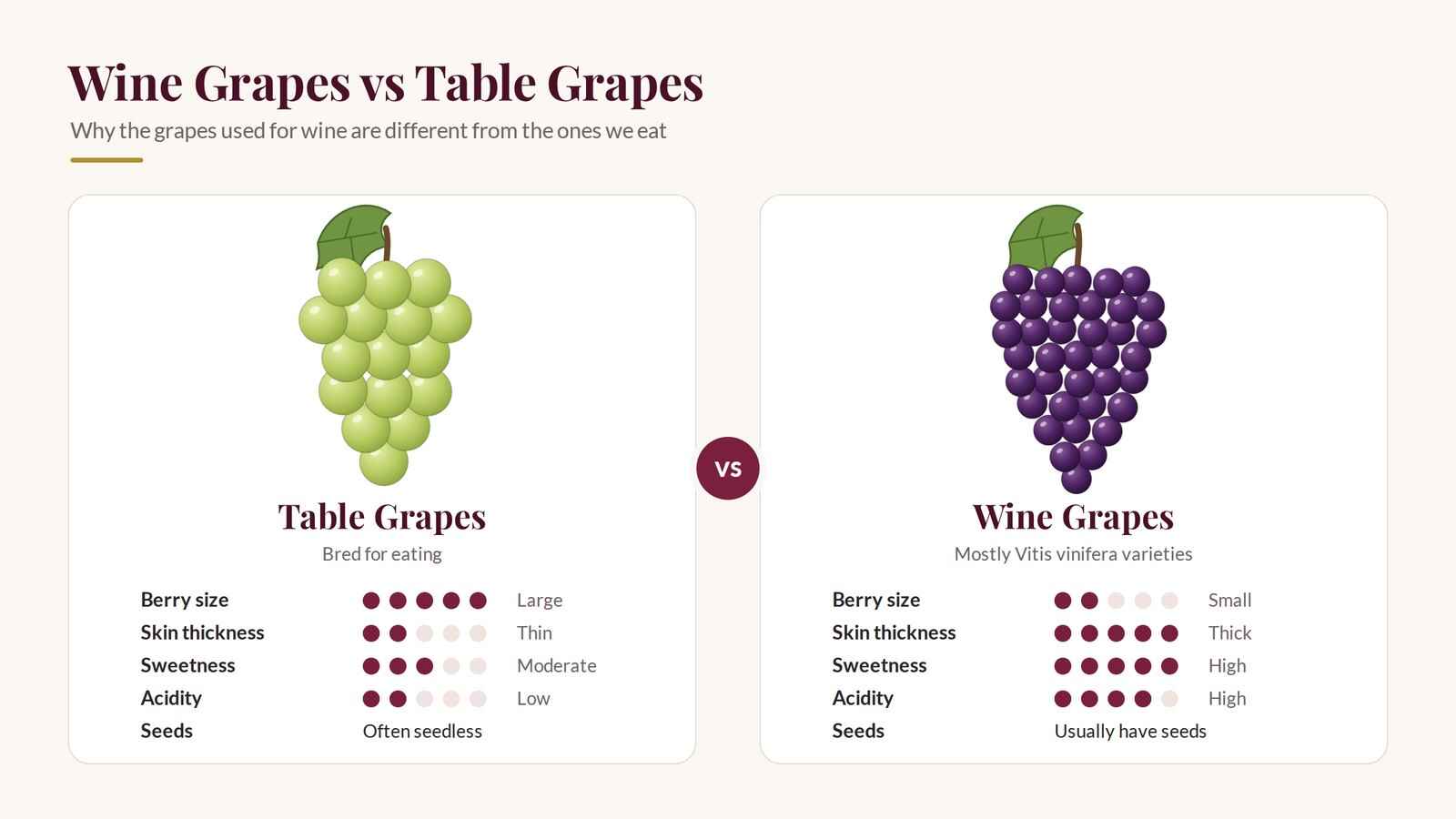
The short answer is grapes. Specifically wine grapes, most commonly from the species Vitis vinifera, a species first domesticated for winemaking in the South Caucasus and Near East. Wine grapes are different from the table grapes we eat. They tend to be smaller, sweeter and more acidic, with thicker grape skins and seeds, making them particularly suitable for winemaking.
During fermentation, yeast consumes the natural sugars in grape juice and produces alcohol and carbon dioxide. That fermented grape juice becomes wine. The finished wine has alcohol, acids, residual sugar (in wines with sweetness), aromas, flavours, and other compounds such as tannins contributing to its character.
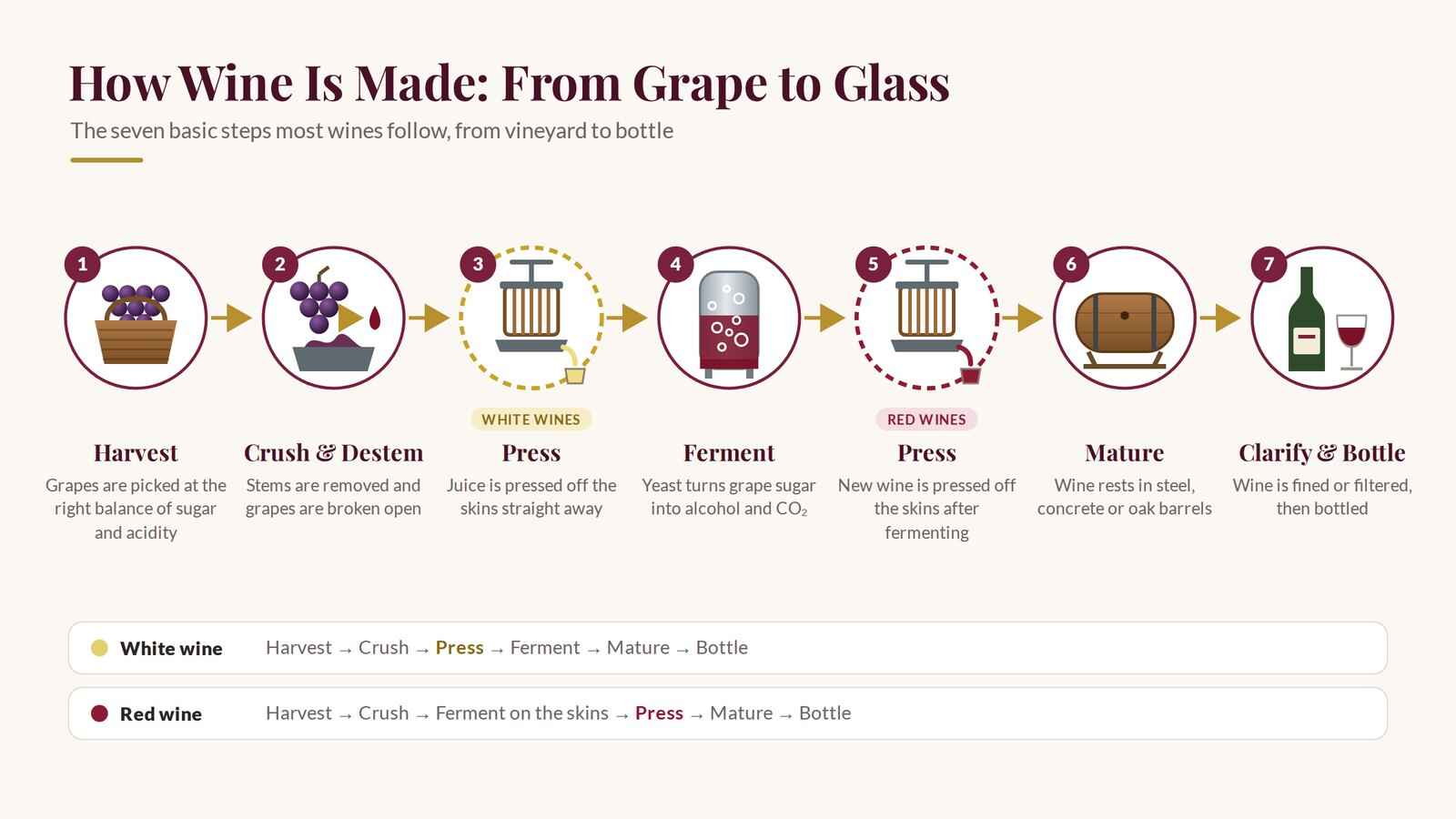
For red wines, the juice is fermented together with the dark grape skins, which give the wine its colour and tannins. For white wines, the juice is usually separated from the skins before fermentation, which is why they are lighter in colour and have little or no tannin.
Can wine be made from other fruits? Yes. Apples, plums, berries and pomegranates can all be fermented into "fruit wines," which are usually named after the fruit (plum wine, for example). Drinks like rice wine (sake) and barley wine are brewed from grains, so they are closer to beer. When people simply say "wine," they almost always mean wine made from grapes, and in many countries the word is legally reserved for it.
What Are Wine Grapes?
They are varieties specifically suited to producing wine, with thousands of grape varieties existing around the world. Almost all of the wine we drink comes from varieties of Vitis vinifera; a few other species, and hybrids between them, are also grown, mainly in North America.
Cabernet Sauvignon, Chardonnay, Pinot Noir, Riesling, Sauvignon Blanc and Syrah are just a few well-known examples. Each grape variety has its own natural characteristics. Cabernet Sauvignon, for instance, is known for its deep colour, firm tannins and blackcurrant flavours, while Riesling is prized for its high acidity and floral, citrus notes.
But the final wine is also influenced by climate, soil, vineyard practices, winemaking and ageing, in other words, where the grapes are growing and how they are handled. That is why the same grape can taste remarkably different when grown in different parts of the world. Grapes growing in warm, sunny climates tend to give riper, fuller wines, while those from cooler climates are often lighter and fresher, with higher acidity.
Variety or varietal? A variety is the grape itself, for example the Chardonnay vine. A varietal is the finished wine made mostly from one variety, for example a bottle labelled "Chardonnay."
What's Actually in a Glass of Wine?
If you are checking the facts, for health, dietary or religious reasons, it helps to know what wine is actually made of once it is finished. Most of it is simply water from the grape. The rest is what gives wine its strength, taste and character.
| Component | Typical amount | What it does |
|---|---|---|
| Water | About 85% | Comes from the grape juice; no water is usually added |
| Alcohol (ethanol) | 8–15% ABV in most table wines; about 15–22% in fortified wines | Warmth, body, and preservation |
| Residual sugar | Under 4 g/L in dry wines; 45 g/L or more in sweet wines, and far higher in some dessert wines | Sweetness |
| Glycerol | Usually about 5–15 g/L | A by-product of fermentation that adds a smooth, rounded feel |
| Acids | Tartaric, malic, lactic and citric | Freshness, balance and stability |
| Phenolics | Mostly from grape skins, seeds and stems | Colour (anthocyanins) and tannins |
| Aroma compounds | Tiny amounts, but hundreds of them | The fruity, floral, spicy or savoury smells in wine |
| Other compounds | Minerals (potassium, magnesium), sulfites, dissolved CO₂ | Stability and, in sparkling wines, bubbles |
A quick note on the grape itself: the pulp holds most of the water, sugar and acid, while the skin holds most of the colour, tannin and aroma compounds. That is why skin contact matters so much in deciding whether a wine becomes red, white, rosé or orange.
How Is Wine Made?
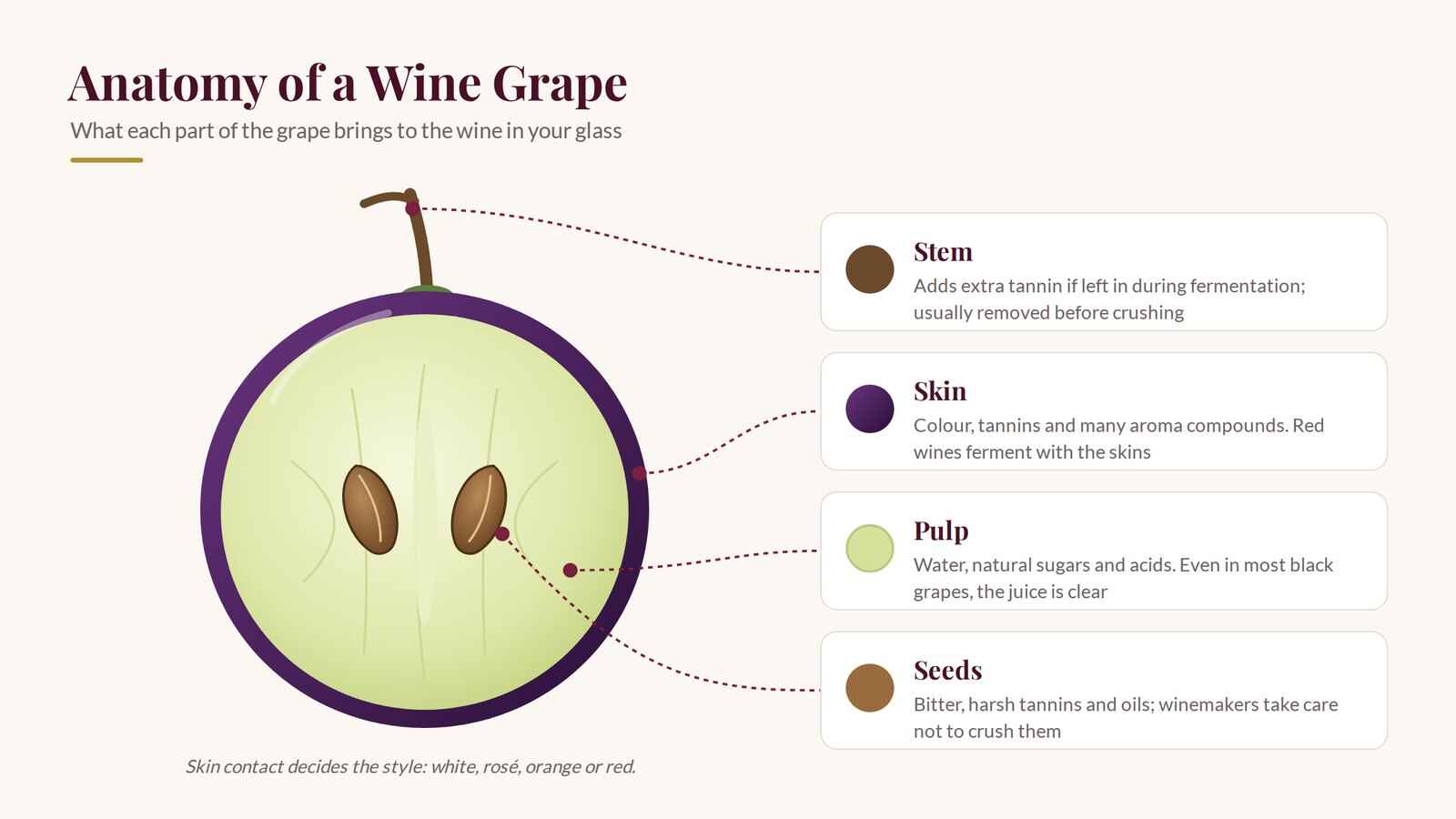
Every winery has its own methods, but most wine follows the same basic journey from vineyard to bottle.
- Harvest. Grapes are picked when they reach the right balance of sugar and acidity. In the Northern Hemisphere that is usually August to October; in the Southern Hemisphere, February to April.
- Crush and destem. The grapes are separated from their stems and gently broken open to release the juice.
- Press (white wines first). For white wines, the juice is pressed off the skins straight away. For red wines, the skins stay in the juice so they can release colour and tannin.
- Ferment. Yeast converts the grape sugars into alcohol and carbon dioxide. This usually takes one to three weeks. Stopping fermentation early leaves natural sweetness in the wine.
- Press (red wines). After fermentation, red wines are pressed to separate the new wine from the skins and seeds.
- Mature. The wine rests in stainless steel, concrete or oak barrels for a few months to several years. Oak can add notes of vanilla, toast and spice.
- Clarify and bottle. The wine is settled, fined or filtered to make it clear and stable, then bottled. Some wines continue to age and improve in the bottle.
Sparkling wines go through a second fermentation that traps carbon dioxide as bubbles, and fortified wines like Port and Sherry have a grape spirit added.
A Brief History of Wine
Wine is one of the oldest drinks made by humans. The earliest evidence of winemaking, dating to around 6000 BCE, comes from present-day Georgia, where wine was fermented in large clay vessels called qvevri, a method still used today. The oldest known winery, around 6,100 years old, was found in a cave in Armenia.
From the Caucasus and the Near East, winemaking spread to ancient Egypt, Greece and Rome. The Greeks honoured wine through the god Dionysus and the Romans through Bacchus, and Roman expansion planted vineyards across much of Europe, including regions that are still famous today. In the Middle Ages, monasteries preserved and refined viticulture, especially in France and Germany. From the 16th century onward, European settlers carried vines to the Americas, South Africa and later Australia and New Zealand.
Wine has also long played a role in religion. It is part of the Christian Eucharist and the Jewish Kiddush, while Islam and some other faiths prohibit alcohol, which is one reason many people look up exactly what wine contains before deciding whether to drink it.
Types of Wine
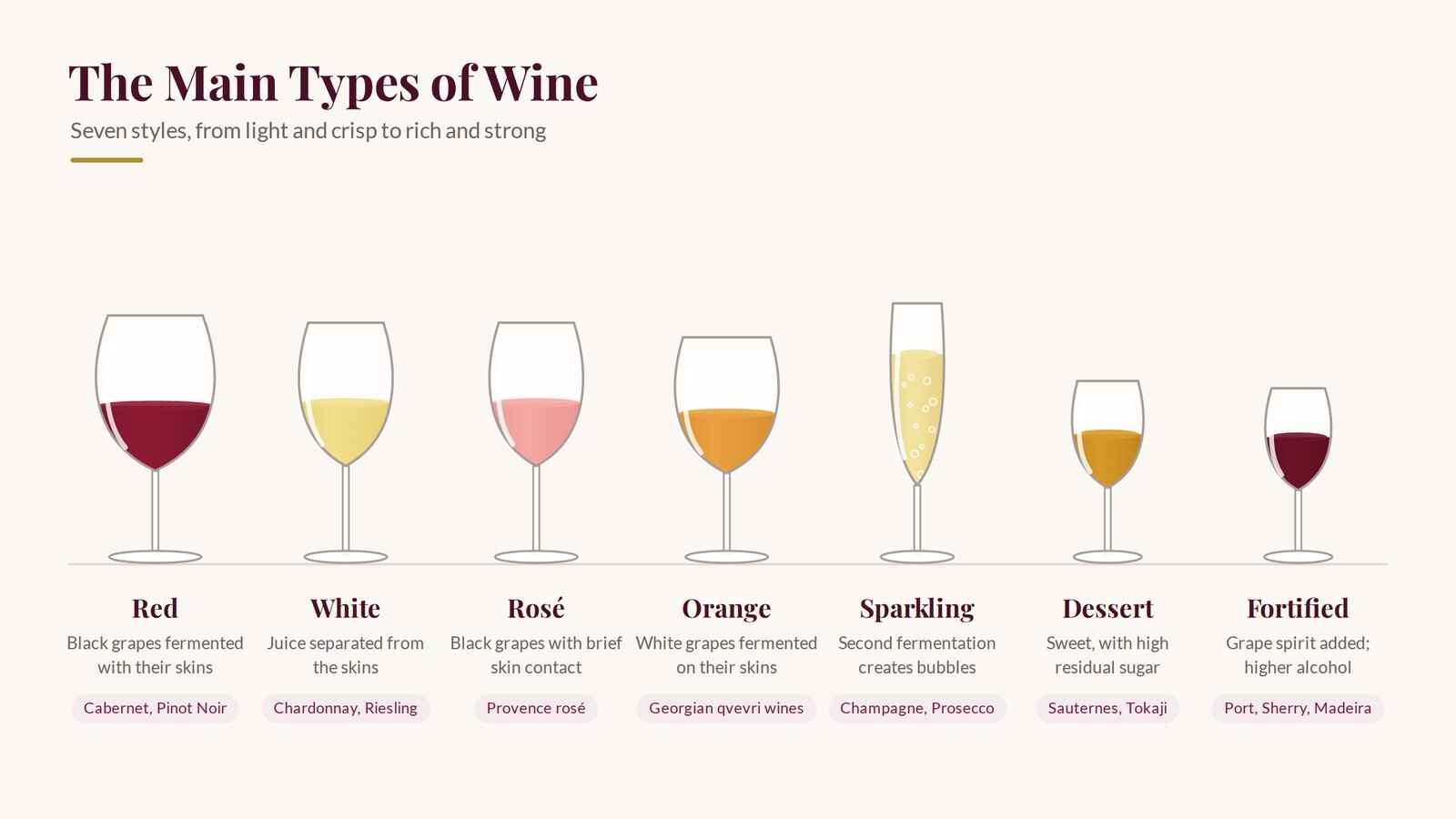
Most people know wine through its main types. Here is a quick overview:
| Type of wine | How it's made | What to expect |
|---|---|---|
| Red wine | Black grapes fermented with their skins | Red to purple colour, tannins, red and black fruit flavours |
| White wine | Usually white grapes, juice separated from the skins | Pale colour, fresh acidity, citrus, apple and stone fruit flavours |
| Rosé wine | Black grapes with brief skin contact | Pink colour, light and fruity |
| Orange wine | White grapes fermented with their skins, like a red | Amber colour, some tannin, dried fruit and nutty notes |
| Sparkling wine | A second fermentation traps carbon dioxide as bubbles | Fizzy, lively and refreshing |
| Dessert / sweet wines | Fermentation leaves noticeable residual sugar | Honeyed, rich and luscious |
| Fortified wine | A grape spirit is added | Higher alcohol, often richer or sweeter (Port, Sherry, Madeira) |
For a deeper look at each style, read our complete guide to the different types of wine:
How Wine Is Classified
Wine can be classified in several ways, including colour, sweetness, carbonation, alcohol level, grape variety, blend, vintage and geographical origin. But we mainly know or hear of red wine, white wine, rosé wine, and sparkling wine. Other information on the label often depends on the wine's country of origin and its local labelling regulations.
| Main classification | What it means | Examples |
|---|---|---|
| By colour | Based primarily on whether wine is made from black or white grape varieties | Red, white, rosé |
| By style | Describes the overall style of the wine | Still, sparkling, fortified, sweet |
| By sweetness | Based on the amount of residual sugar or sweetness in the final wine | Dry, off-dry, medium-sweet, sweet |
| By grape variety | The wine is identified by the principal grape used | Chardonnay, Pinot Noir, Cabernet Sauvignon |
| Single-varietal wine | Made predominantly from one grape variety | Chardonnay, Sauvignon Blanc |
| Wine blend | Made by combining two or more grape varieties | Bordeaux blend, GSM blend |
| By vintage | Identified by the year in which the grapes were harvested | 2022, 2023, 2024 |
| Non-Vintage (NV) | Made by blending wines from different harvest years | Many Champagnes |
| By geographical origin | Identified by where the grapes were grown, often under specific regional rules | Bordeaux, Chianti, Napa Valley |
| By appellation | A legally defined geographical designation with rules defining production | AOC, DOC/DOCG, AVA |
| By alcohol level | Can also be broadly described according to alcohol content or wine ABV | Low, moderate or high-alcohol wines |
An important point for beginners in wine: these classifications can overlap. For example, a bottle can be a dry, red, still, single-varietal Cabernet Sauvignon from Napa Valley, with a 2022 vintage. The label brings these pieces of information together, helping you understand what is in the bottle and where it comes from. Don't miss: A Simple Guide to Understanding Any Wine Label
Four of these classifications deserve a closer look.
Single-Varietal Wine
A single-varietal wine is made predominantly from one grape variety and is usually named after it, such as a Chardonnay or a Sauvignon Blanc. "Predominantly" is the key word: the minimum share of the named grape is set by local law, so a single-varietal wine may legally contain a little of other grapes.
| Country / region | Minimum % of the named grape |
|---|---|
| European Union (France, Italy, Spain, Germany, etc.) | 85% |
| Australia | 85% |
| New Zealand | 85% |
| South Africa | 85% |
| United States (federal rule) | 75% |
| Oregon, USA | 90% for most varieties |
Single-varietal wines are a great way for beginners to learn how individual grape varieties taste.
Wine Blend
A wine blend is made by combining two or more grape varieties. Winemakers blend to build balance and complexity, pairing one grape's structure with another's fruit, aroma or softness.
Famous examples include the Bordeaux blend (typically Cabernet Sauvignon and Merlot, often with Cabernet Franc and others) and the GSM blend (Grenache, Syrah and Mourvèdre) from the Southern Rhône and beyond. Blending is not a sign of lower quality; many of the world's most celebrated wines are blends. You may also see a blend called a cuvée, especially in Champagne, which is usually champagne grape variety of Chardonnay, Pinot Noir and Pinot Meunier.
The Origin of the Term "Vintage"
The word vintage comes from the French vendange, meaning "grape harvest," which traces back to the Latin vindemia, from vinum (wine) and demere (to take away), literally "taking the grapes." In English, the spelling shifted under the influence of vintner, the old word for a wine merchant.
Grapes ripen once a year, so each harvest produces one vintage. On a wine label, the vintage is simply the year the grapes were harvested. It matters because weather changes every year. A warm, sunny season can produce riper, fuller wines, while a cool or rainy one may give lighter, more acidic wines from the very same vineyard. Because harvests happen at opposite times of year in the two hemispheres, a 2026 Argentine wine was picked around March, while a 2026 French wine was picked around September. In exceptional years, Champagne houses release vintage bottles; see the best vintage Champagne years.
Non-Vintage (NV) Wine
A non-vintage (NV) wine is made by blending wines from different harvest years. Producers do this to create a consistent house style year after year, smoothing out the differences between good and difficult seasons.
Non-vintage is especially common in Champagne and other sparkling wines, as well as in some fortified wines such as many Sherries and Ports. NV does not mean lower quality; it simply means the wine's character comes from blending across years rather than from a single harvest.
The Taste of Wine: The Main Components
Different types of wine can have the following components in varying degrees. Various wine terms and descriptors are used to identify these characteristics as they appear in different wine styles.
1. Flavours
Flavours are the taste impressions you experience when drinking wine, such as citrus, apple, berries, peach, spices or chocolate. They come from the grape variety, winemaking, ageing and the environment where grapes grow.
2. Aromas
Aromas are the smells you notice in the wine, and they can range from fresh fruit and flowers to herbs, spices, vanilla or toast. Much of what we perceive as "flavour" actually comes through our sense of smell.
3. Sweetness
Sweetness comes from residual sugar, which is the natural grape sugar left in the wine after fermentation. Wines can range from dry, having little or no perceptible sweetness, to sweet wines with noticeably higher levels of sugar.
4. Acidity
Acidity gives wine its freshness and creates a mouth-watering sensation, much like lemon or green apple. It helps balance sweetness and is particularly important in making wine feel lively rather than flat. Wine is quite acidic, typically around pH 3 to 4, similar to many fruit juices.
5. Tannins
Tannins are naturally occurring compounds found mainly in grape skins, seeds and stems, and they create a drying or slightly grippy sensation in the mouth. They are especially noticeable in red wines and can soften as the wine ages.
6. Alcohol
Alcohol gives wine warmth and contributes to its body and texture. Most table wines contain roughly 8 to 15% alcohol by volume. There are wines that fall outside this range.
7. Body
Body describes how light or heavy a wine feels in your mouth. Imagine the difference between skimmed milk and cream. Alcohol, tannins, sweetness, acidity and other components all contribute to the wine's overall weight and texture.
8. Finish
The finish is the lasting flavour and sensation that remain in your mouth after you swallow or spit the wine. A long finish, often found in complex wines, means the wine's flavours and sensations linger on in a pleasant way. The short finish of a simple wine disappears relatively quickly.
How to Taste and Serve Wine
You don't need special training to taste wine well. Try these four steps with your next glass:
- Look. Tilt the glass against a white background and note the colour and depth.
- Swirl. Gently swirl the wine to release its aromas.
- Smell. Take a short sniff and think about what you notice: fruit, flowers, spice, oak?
- Sip. Let the wine coat your mouth, then notice its sweetness, acidity, tannin, body and finish.
The right glass helps too; see our guide to different types of wine glasses. Serving temperature makes a big difference to how a wine tastes:
| Wine style | Serving temperature |
|---|---|
| Sparkling wine | 6–10°C (43–50°F) |
| Light whites and rosé | 7–10°C (45–50°F) |
| Fuller whites (e.g. oaked Chardonnay) | 10–13°C (50–55°F) |
| Light reds (e.g. Pinot Noir) | 12–14°C (54–57°F) |
| Fuller reds (e.g. Cabernet Sauvignon) | 15–18°C (59–64°F) |
| Sweet and fortified wines | 8–16°C, depending on style |
Short on time? Here is the best way to chill wine fast. For bubbly, see our guide to serving Champagne at the right temperature.
For more tips, read How to Serve Wine and How to Drink Wine Proficiently.
For food, a simple rule works well: match light wines with light dishes and fuller wines with richer dishes. High-acid whites cut through creamy or oily food, while tannic reds pair well with red meat. Our food and wine pairing guide covers this in detail.
Major Wine Regions Today
Wine is now produced on almost every continent. Today both historic and emerging wine regions contribute to the global wine landscape.
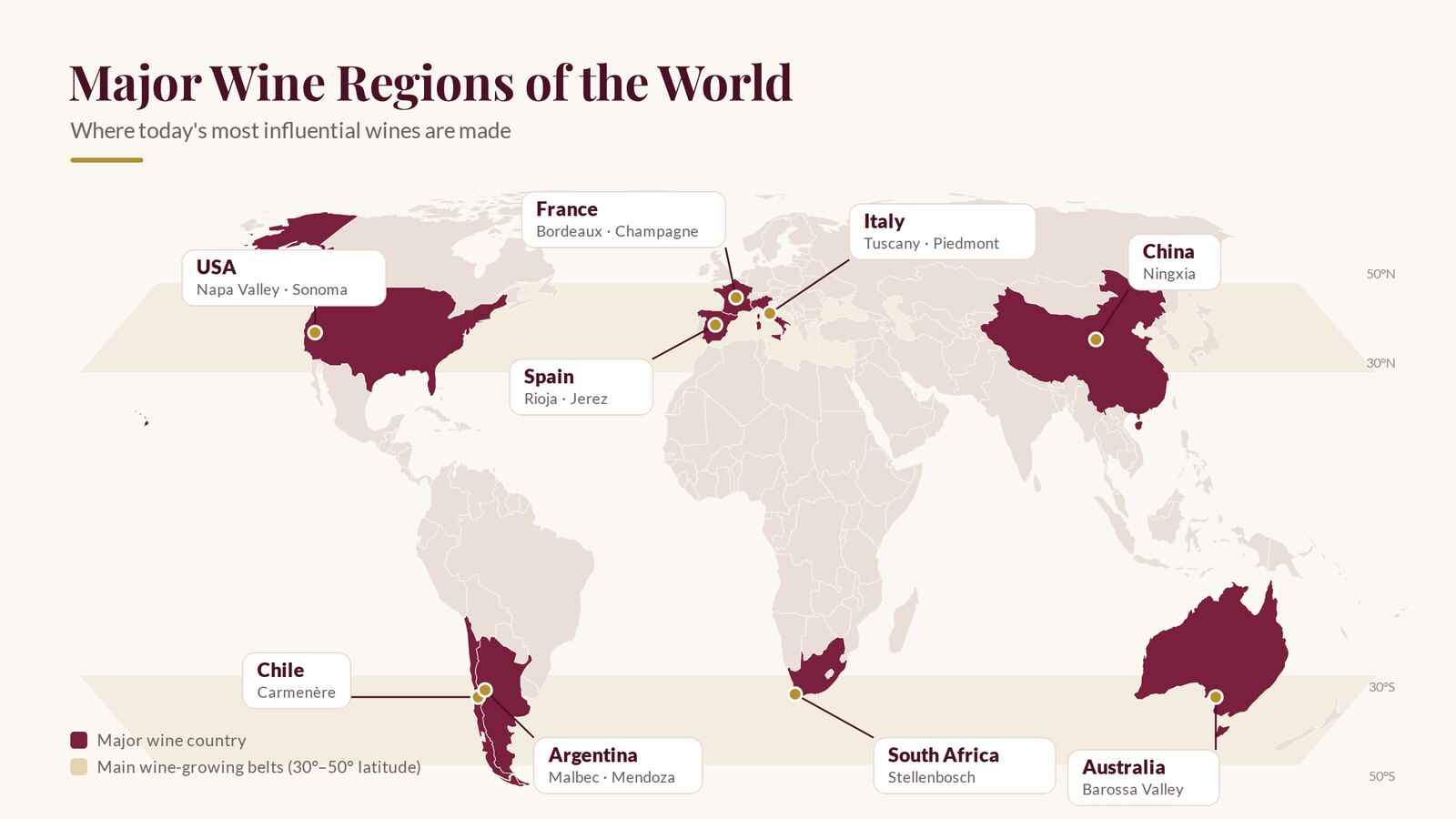
France remains one of the world's most influential wine countries, home to regions such as Bordeaux, Burgundy, Champagne, Rhône, Loire and Alsace. French wine culture has had an enormous influence on grape varieties, winemaking and wine terminology worldwide.
Italy is one of the world's most diverse wine countries. Italy's wine regions stretch from Piedmont and Veneto in the north to Tuscany, Sicily and Puglia in the south. It is particularly known for its extraordinary range of indigenous grape varieties. See our pick of the best Italian wines.
Spain offers a remarkable combination of old vineyards, native grapes and varied climates. Rioja, Ribera del Duero, Priorat, Rías Baixas and Jerez are among its best-known wine regions.
USA: The United States has a major wine industry, with California leading production. Regions such as Napa Valley, Sonoma and the Central Coast don't really need an introduction. Oregon and Washington also produce distinctive wines. Explore famous wineries in Napa Valley and the best California white wines.
China has one of the largest vineyard areas in the world and is one of the fastest-rising names in wine. Ningxia, at the foot of the Helan Mountains, has earned international recognition, alongside regions such as Shandong, Xinjiang and Yunnan. Cabernet Sauvignon is the country's leading red grape.
Australia is known for regions including Barossa Valley, Margaret River, Yarra Valley and Hunter Valley. Grapes like Shiraz, Chardonnay and Cabernet Sauvignon are among its important varieties for Australian wine.
Chile's long, narrow geography creates a fascinating range of climates. Cabernet Sauvignon, Carmenère, Sauvignon Blanc and Chardonnay are among its notable wines.
Argentina is particularly famous for Malbec, especially from Mendoza, but also produces excellent Cabernet Sauvignon, white wines from Torrontés and other varieties.
South Africa combines an old winemaking history with a modern, dynamic industry. Stellenbosch, Swartland, Constantia and Hemel-en-Aarde are among its notable regions, producing everything from Chenin Blanc to Cabernet Sauvignon and Pinot Noir.
What Is an Appellation? (AOC, DOC and AVA)
If wine labels sometimes seem like a geography lesson, there is a reason. An appellation system identifies wines according to their geographical origin. Depending on the regional laws, it may also specify permitted grape varieties, production methods and other requirements.
Take a look at a few examples to understand these systems within the well-known wine regions.
- France – AOC (Appellation d'Origine Contrôlée): The system links a wine's characteristics to a grape variety, a defined geographical area and recognised production practices. France also has IGP category wines, which are generally simpler and more fruit-forward.
- Italy – DOC (Denominazione di Origine Controllata): A traditional designation within the country's protected-origin system. Italy also has DOCG (a higher category than DOC) and IGT (simple, fruity) categories.
- USA – AVA (American Viticultural Area): A defined grape-growing area with distinguishing geographical or climatic features. The US currently has hundreds of established AVAs, with California containing the largest number.
These systems help communicate where a wine comes from and, in different ways, the rules and traditions associated with that place.
Why Wine Makes a Great Gift
Wine gifts are particularly thoughtful because they can be personal without being overly complicated. Great wine gifts can mark a birthday, anniversary, dinner invitation, promotion or celebration in a special way. You can choose a wine based on someone's favourite grape, region, occasion or even a memorable place they have travelled to.
And unlike many gifts, wine can become part of an experience: opened over dinner, shared with friends or saved for a special occasion. Whether you choose one of the best red wines for gifts or a white wine gift, wine rarely misses. If you're buying for someone who is new to wine, our guide to the Best Wine for Beginners can help you choose a bottle that is approachable and easy to enjoy.
Also read: 10 Reasons Customers Choose Wine & Champagne Gifts for Meaningful Gifting
Frequently Asked Questions About Wine
What is wine in simple words?
Wine is an alcoholic drink made by fermenting grape juice. Yeast turns the natural sugar in grapes into alcohol and carbon dioxide.
What is wine made of?
Finished wine is about 85% water, plus alcohol (usually 8–15%), acids, glycerol, a little or a lot of sugar depending on style, and small amounts of colour, tannin and aroma compounds from the grapes.
Does all wine contain alcohol?
Yes, by definition wine contains alcohol, usually around 8% to 15% ABV for table wines and more for fortified wines. "Non-alcoholic" or "alcohol-free" wines are made as wine and then have most of the alcohol removed; many still contain a trace amount, so check the label if you avoid alcohol completely for religious, health or personal reasons.
Is wine vegan or vegetarian?
Not always. Some wines are clarified ("fined") with animal-derived products such as egg whites, milk protein, gelatin or isinglass (from fish). Look for wines labelled vegan or vegetarian if this matters to you.
What are sulfites in wine?
Sulfites are compounds produced naturally in small amounts during fermentation and often added in small quantities to protect wine from spoilage. Many countries require labels to state "contains sulfites," as some people are sensitive to them.
How long does wine last once opened?
Most still wines stay fresh for about 3–5 days once opened if you recork them and keep them in the fridge; sparkling wines lose their bubbles within 1–3 days. Learn how to store an open bottle of wine and how to tell if wine has gone bad.
Is wine gluten-free?
Yes. Wine is made from grapes, not grain, so it is naturally gluten-free. Any traces from winemaking materials are generally far below the levels that affect most people with coeliac disease, but anyone highly sensitive should check with the producer.
How many calories are in a glass of wine?
A standard 150 ml (5 oz) glass of dry wine at around 12–13% ABV contains roughly 120–130 calories, mostly from the alcohol. Sweet and fortified wines contain more. See Wine and Calories Made Easy and Calories in Red Wine for a full breakdown.
Is wine good for your health?
Wine contains alcohol, and health authorities such as the World Health Organization advise that no amount of alcohol is risk-free. Older claims that moderate wine drinking protects the heart are now widely debated. If you choose to drink, drink moderately, and speak to a doctor if you have health concerns.
How long does it take to make wine?
Fermentation takes one to three weeks, but most wines then mature for several months before bottling. Some fine wines are aged for years in barrel and bottle before release.
What does "NV" mean on a wine label?
NV stands for non-vintage: the wine is a blend of wines from more than one harvest year, which is common in Champagne.
Can wine be made from fruits other than grapes?
Yes. Fruit wines are made from apples, berries, plums and more. But when people say "wine" without qualification, they almost always mean wine made from grapes.
What is the difference between red and white wine?
Red wine is fermented with dark grape skins, giving it colour and tannins; white wine is usually made without skin contact. See our detailed guide, Red Wine vs White Wine.
Final Thoughts
So, what is wine? At its simplest, it is fermented grape juice. But that simple definition only tells part of the story. Wine is shaped by grape variety, climate, soil, vintage, human decisions, tradition and time. It can be a product of agriculture, an expression of place, a great pairing with food and, for many people, a way of connecting with culture and other people.
Whether you're just beginning to explore wine or already know your Cabernet from your Chardonnay, there is always another bottle, region or grape waiting to tell you something new. And perhaps that is the most interesting thing about wine: it is simple enough to begin with, but complex enough to keep discovering.