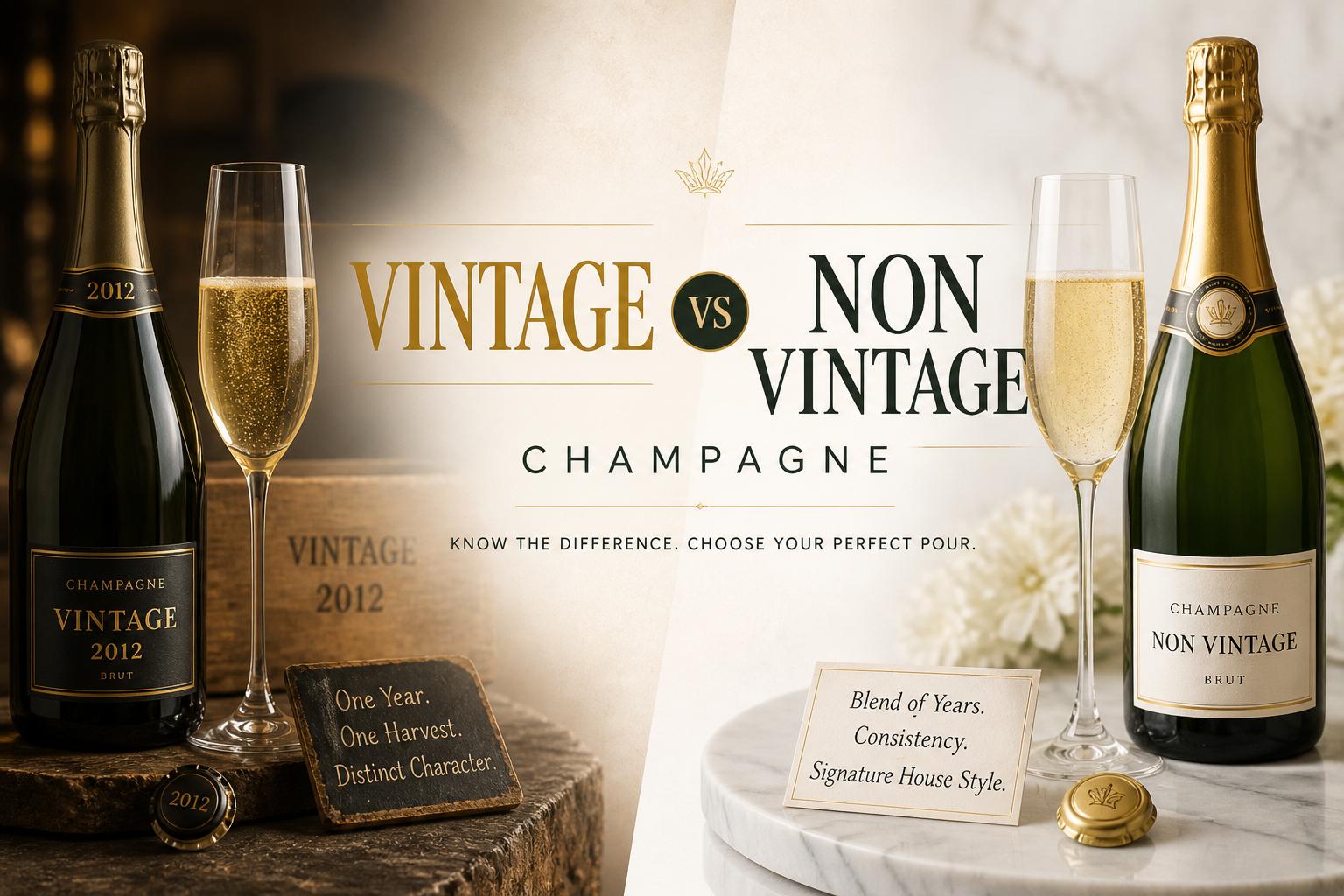
Your first encounter with the concept of vintage vs. non-vintage champagne can feel confusing, especially because champagne works a bit differently from most other wines. But once you get a grasp of the difference between vintage and non-vintage champagne, the knowledge can be used to choose or recommend a champagne. At its core, this comparison is about two philosophies: one expresses the true soul of a single exceptional year, while the other is all about maintaining a high quality and a consistent house style through blending.
What is Vintage Wine?
A vintage wine is made from grapes harvested in a single year therefore, showcasing that year’s expression through the wine itself. That means climate, rainfall, temperature, soil, and the overall terroir directly influence the wine’s character. In a nutshell, a vintage wine captures an image of that year in the vineyard and presents it to you to drink and savour it.
When Do Wineries Declare a Vintage?
In champagne a vintage is not declared every year. It is declared when the growing year is forecasted to be exceptional with regard to climate and the harvest will be exceptional to stand on its own. Champagne law states for the growers to have consensus when declaring a vintage which can be done only after securing approvals from the regulatory body. Meaning, lots of checks and balances are in place and hence a vintage champagne is relatively rare.
What percentage of Grapes Must Come from That Year?
In most regions typically, a vintage wine must contain at least 85% of the grapes from the year stated on the label. In case of vintage champagne, 100% of the grapes used are from the mentioned year.
NV Wine Meaning (Non Vintage Wine Meaning)
Now let’s understand the meaning of NV wine. NV - non vintage wine is the one crafted from grapes of multiple harvest years. This is particularly important in the champagne region where consistency is key. Another example of an iconic region that typically blends varieties across years to produce some of the world’s most premium red wines is Bordeaux wine region.
What Does NV Mean on a Champagne Bottle?
If there is no fear mentioned on a Champagne bottle, it is a non-vintage (NV) champagne. Sometimes you may see the letters MV meaning multi-vintage, it essentially means the same thing.
Why do Winemakers Prefer Non Vintage Blends?
Blending allows winemakers to maintain a consistent house style, one for which they’re known and draws the loyalists back over and over. The cellar master blends different base wines to create that perfect blend to achieve a recognisable flavour profile every year. The familiarity of the flavours and associated likeness is what draws people back to NV champagne which by no means lacks quality and balance.
What is “Reserve Wine” and How is it Used in NV?
Reserve wine refers to old wine with great flavour concentration and balance, kept aside and blended into newer vintages. These wines add depth, complexity, and continuity to the final blend. Iconic champagne houses like Billecart Salmon are known for their sophisticated use of reserve wines. Fact is, NV - non vintage champagne dominates production, accounting for roughly 90-95% of total output, making it the backbone of the region
Difference Between Vintage & Non-Vintage Champagne
Understanding the difference between vintage and non-vintage becomes easier when you compare them side by side
| Factor | Vintage Champagne | Non-Vintage Champagne |
|---|---|---|
| Production | Single harvest year | Blend of multiple years |
| Aging (Champagne) | Minimum 3 years | Minimum 12 - 15 months |
| Flavour | Complex, rich, evolving | Fresh, consistent, approachable |
| Volume | 3–5% of production | 90–95% of production |
| Price | Higher (premium to super-premium) | Lower (entry to mid range) |
| Cellaring | 5 to 20+ years | 3 to 5 years |
| Label | Year printed on the label | NV or no year printed on the label |
This table clearly shows how vintage vs non vintage champagne differs not just in production, but also in style, aging potential, and price.
Taste & Flavour
How Do They Differ in the Glass?
The real magic of vintage vs non vintage champagne becomes evident in the glass. Vintage Champagne is shaped by extended aging on lees (dead yeast sediment) in the bottle, which leads to complex, autolytic notes (aromas and flavours from yeast autolysis when dead yeast reacts with wine’s flavour compounds) like brioche, toasted nuts, and a honeyed richness. Over time, these wines evolve into deeper, more layered expressions.
Non-vintage Champagne, on the other hand, is designed for immediate or fairly early pleasure. Expect fresh citrus, green apple, floral notes, and vibrant acidity. It is bright, clean, and consistent. And another pro-tip is to choosing the right champagne glass - I assure you this matters the most to bring out the best in any champagne.
Does Vintage Wine Always Taste Better?
Not necessarily. While vintage wines offer complexity and depth, non-vintage wines provide balance, familiarity, and reliability. The choice depends on what you’re looking for at the moment.
What Flavours to Expect From NV Champagne?
NV champagne typically leans towards orchard fruits, zesty citrus, and subtle bread like notes - making it incredibly versatile and easy to enjoy.
How Does Aging Changes The Flavours of Vintage Wine?
A vintage wine has great flavour concentration and is very expressive, further aging in the bottle allows the flavour complexity to rise and get more nuanced. Vintage wines and champagnes are incredibly well balanced, bottle aging elevates these characteristics with time.
Aging & Cellaring : Which Wine Lasts Longer?
A key aspect of vintage vs non-vintage wine is longevity. Vintage Champagne is built for aging. With every bottle aging for a minimum of three years (often much longer in practice) on lees, it can develop beautifully over a decade or two, even more, because there concentration and balance that aids positive aging. Prestige cuvées like Dom Perignon are specifically designed for long term evolution. Non-vintage Champagne, by contrast, is best enjoyed within 3 to 5 years of release. While it undergoes at least 15 months of aging (including time on lees), it is crafted for freshness rather than extended cellaring or ageing.
How Long Does Non-Vintage Champagne Last?
Typically up to five years, depending on storage conditions. Champagne and all other wine needs proper storage conditions - cool constant temperature, right humidity levels being the most important.
How to Store Vintage Wine at Home?
Wine or champagne bottles should be stored horizontally in a cool and dark place at a temperature of around 13°C to 15°C. Warm temperature and direct light spoils the fruitiness and balance of the wine over time
Price : Why is Vintage Wine More Expensive?
One of the most searched aspects of vintage vs non vintage champagne is pricing. Vintage Champagne is more expensive because it is:
- Produced only in exceptional years
- Aged longer (higher storage cost)
- Released in limited quantities
- Positioned as a premium or prestige cuvée
Iconic examples like Dom Pérignon perfectly highlight how vintage wines carry both scarcity and status, often raising the question among buyers, what truly makes it so special and is it worth the price? You can explore this in detail in our blogs on Dom Perignon price and Dom Perignon guide. Non-vintage Champagne, in contrast, benefits from consistent production and availability, making it more accessible.
Vintage vs Non Vintage Beyond Champagne : Port, Still Wines
The concept of vintage vs non-vintage stretches far beyond champagne and is actually applicable to all wine styles. Most still wines can be vintage, if the year is mentioned on the label. However, in case of fortified wines like port wines:
- Vintage Port is made only in exceptional years and therefore has an unmatched aging capability.
- Tawny Port is non-vintage but has intense and concentrated aromas and flavours.
Sherry on the other hand is predominantly non-vintage, as the aging process occurs in a solera system which relies heavily on blending across years.
How to Read a Wine Label : Vintage or NV?
Understanding what NV means on a champagne bottle becomes easy once you know what to look for. If a year is printed clearly on the label, it is vintage. If there is no year - or you see “NV” - it is non-vintage. Some producers may also use “MV” (multi-vintage), which means the same thing. Prestige cuvées almost always display a vintage year, reinforcing their focus on a specific harvest.
Which Champagne Bottle Should You Choose? (Occasion Guide)
This ultimately comes down to the occasion and quite importantly, the personal choice. Non-vintage champagne is made with the same care and traditional technique - Méthode Champenoise or The Traditional Method. It is perfect for casual celebrations, everyday luxury, indulgence, and times where you’re simply looking for comforting familiarity.
Vintage champagne is a lens to an exceptional growing year. It exhibits the terroir and craftsmanship quite beautifully even as it evolves to get more complex with age. It is best reserved for milestone occasions, meaningful champagne gifts, or when you want to experience the depth and personality of a great growing year. All types of champagne pairs well with varied cuisines and dishes - try some scrumptious champagne and food pairings to elevate your next dinner party.
What is NV Champagne, how is it different from MV and vintage bottlings?, and Which is best?
To summarise:
- NV Champagne: Blend of multiple years
- MV Champagne: Another term for NV
- Vintage Champagne: Single exceptional year
Which is best depends entirely on the occasion and personal preference.
Best Recommendations for Vintage & Non-Vintage Champagne
For non-vintage champagne, we’ve put together some excellent examples with consistent house styles to choose from. And the best part? These are gift ready for you to order now :
- Veuve Clicquot Yellow Label Champagne & Dubai Chocolate Gift Set
- Moet & Chandon Imperial Brut & Godiva Chocolate Gift Set
- Bollinger Special Cuvee
- Laurent Perrier Cuvee Rose Gift Set
For vintage champagne, our in-house expert’s picks are the ones that showcase the richness and complexity that define exceptional vintages:
- The Ultimate Dom Pérignon Gift Set
- Louis Roederer Cristal with Black Caviar Gift Set
- Bollinger La Grande Annee
- Boizel Grand Vintage Champagne 2007
- Billecart-Salmon Cuvee Nicolas Francois 2008
The Advantages of Vintage Champagne Over Non-Vintage Champagne: Everything You Need to Know
Vintage Champagne offers greater depth, individuality, and a great aging potential. It reflects a specific harvest and evolves over time, making it more complex and expressive. However, non-vintage Champagne excels in consistency, accessibility, and immediate enjoyment - qualities that make it indispensable.
Final Thoughts
The whole dialogue around vintage vs non-vintage isn’t about which is better - it's actually about understanding the intention behind each. Vintage Champagne expresses a single year, shaped by nature's goodwill. Non-Vintage Champagne expresses the vision of the producer, shaped by the winemaker’s expert and consistent blending. Once you understand the distinction, you don’t just drink champagne - you choose and appreciate it with purpose.
FAQs
Is vintage champagne better than non-vintage?
What does NV mean on a Champagne bottle?
-
How long can you keep non-vintage Champagne?
What is a good vintage year for Champagne?
Does vintage wine get better with age?
What is the difference between MV and NV?
How do you know if a wine is vintage?
Why is Dom Pérignon only vintage?
Not always. Vintage offers complexity and aging potential, while non-vintage delivers consistency and approachability.
It stands for Non-Vintage, meaning the wine is a blend of multiple harvest years.
Typically 3 to 5 years from release. For best results, proper storage plays a key role, learn how to store Champagne correctly
Notable recent years include 2008, 2012, and 2015, though quality depends on the producer.
Many do, especially those with high acidity and structure, like Champagne.
There is no real difference - MV (multi-vintage) is simply a modern term.
Look for a harvest year on the label.
Because it is designed to express only exceptional harvests, it never blends across years.